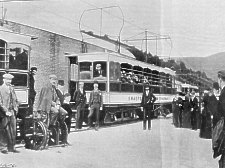
Starting Point
[From The Electrical Review vol 37 #920 pp312 15 Sept 1895]
Some few days ago we had the pleasure of travelling over the most interesting electric railway in the British Isles. When we rode over the complete length of the Douglas and Laxey line last year the experience was novel and occasionally exciting, but it fell far short of that gained on a journey up the Snaefell Mountain.
The Snaefell Mountain Railway is not, as has been supposed, a continuation of the Douglas and Laxey Electric Tramway, although the terminus of the one and the starting point of the other are only a little distance apart.
Starting Point
The Mountain Railway is nothing more than a pleasure line, and will entirely suspend operations at the end of the season, The line is interesting, not only because it is the first time electricity has been utilised in this country on such heavy grades, but on account of the extraordinary rapidity which has marked its construction,
The line starts at the north end of Laxey town, hard by the renowned wheel, and commencing with a steep ascent of 1 in 12 winds round the face of the mountain, The length of the line is just under 5 miles, and though the gradient is, for the most 1 in 12, on no part of the track is a rack used, Considering this, it is astonishing how easy the cars do the climbing ; even on days when the rails must be to some extent greasy there is not the slightest trouble in propelling the cars at a speed of 10 miles an hour.
Although the scenery that is encountered by the new mountain railway is grand, it has none of the romance and little of the picturesque beauties that one meets, for instance, in Groudle Glen. We see some wonderful bits of nature, however—nature in its majestic mood—and we just gain a fleeting glimpse of the famous Sulby Glen traversed by the road to Ramsay, which indicates what one may expect from the summit on a clear day.
We made the ascent of Snaefell early in the morning, long before the Douglas tripper had spread himself over the land. It was raining hard, and had been doing so since 6 o'clock ; indeed, we are quite convinced that much self-abnegation was needed to make the journey under such dismal conditions. It would, however, take a good deal of rain to efface the beauties of Laxey, and one obtains a good idea of the character of the country when standing on the slight eminence at the foot of Shaefell, which serves as the station or the starting point, We take our seats on the car, and little time is wasted in making a start ; a short run on the flat enables the car to get fairly under weigh[sic way] before commencing the climb; 1 in 12, however, makes little difference in the speed of the car, and we rapidly leave the valley behind us. The track is a double one throughout, and the journey up is for the most part on the outside metals ; this enables one to make rough calculations as to how far one would roll if certain contingencies were to arise, and the value of Tit-Bits in such an emergency occasions earnest speculation.
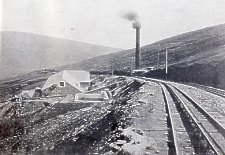
View of line showing Generating Station.
There is very little opportunity to be nervous, however, for the scenery and the line because of engrossing interest, The rise is most marked some quarter of a mile from the startin point, and gives occansion for a conundrum as to which way a stream runs whose course is just visible on the other side of the valley, The answer seems easy, but it is invariably wrong ; for while appearing to run from right to left on account of an apparent fall in the watercourse, there is really no fall, and the stream flows the other way; indeed, makes its way to the Laxey wheel which we have left far behind. A little more variation in the scenery, and we ran on the level, and stop half-way up the line, close by the generating station, A view of this is given in one of our illustrations, which, by the way, is not intended to show the beauties of the surrounding scenery, for the spot hereabouts is a wild one. It is interesting, however, in showing the car in the distance coming up the slope, as well as the construction of the track, Continuing the journey, we pass round to the other side of the mountain, and gain our first view of the sea, Shortly afterwards we reach the top of Snaefell, and, apart from all technical considerations, the journey was well worth asking if only for the wonderful view to be obtained from the summit. Ramsay and the surroundine country lay at one's feet like an unrolled map, while dimly limned in the distance was the coast of Ireland, and the Mull of Galloway just peeps over low-lying clouds. We were told that on certain days the Irish cornfields can be plainly seen; but then the air of Snaefell is exhilarating, and the Mountain Hotel is capital one. The return journey was quite as impressive as the outward one. Perhaps the most striking feature—not scenic one, by the way—was the complete control of the car ; there was very little variation in speed, the maximum on the steepest grades being never more than 10 miles an hour.
Having dwelt—very inadequately, we fear—on some of the special features of a ride in a mountain car,it becomes necessary to say something about the details of the line. The most astonishing thing about the line is the rapidity with which it has been completed. It was not till January of this year that the contractors commenced to make the road. They encountered throughout the work the most trying weather ; they were interrupted time after time, and had frequently to do work twice over, Yet in spite of all these extraorinary obstacles, the work was completed by August 24th - a magnificent performance in every way. Such work has naturally called for great pewers of endurance, and all those who have taken part in it, from the highest to the lowest, are deserving of great commendation, We do not think for a moment that the construction has in any way suffered by reason of rapid completion ; there is, at any rate, nothing to suggest hurried work. We have already said that the line has been constructed on the face of the mountain, cuttings and tunnels having been avoided in order that an uninterrupted view may be obtained at all points of the line, The permanent way has, for the most part, been excavated, the removed ground being banked to form the outer portion of the line. The varying nature of the soil has, in some cases, necessitated special precautions ; but there seemed to be little likelihood of undue strain on the embankment causing anything in the nature of a collapse.
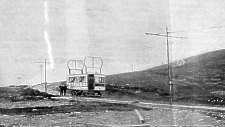
Line showing cutting in the distance.
The gauge of the line is 3 feet 6 inches, and as we have already said is double track throughout. The curves are fairly sharp in some places, the greatest curvature being one of a radius of 10 chains. The rails are of cast-steel, and weigh 50 lbs. to the yard. Fish plates are used at the joints, spring washers being used on the fish bolts, and the ends of the rails are secured by fang bolts to the sleepers.
The most novel and interesting feature of the track, however, is the use of a centre rail. This is part of what is known as the Fell system, and is due to Mr. G. Noble Fell, who has laid out and personally superintended the construction of the line. The centre rail is a double headed one, carried on wrought-steel chains. A good idea of this rail will be gleaned from the view of the generating station. The use of this rail is confined entirely to the steep gradients. It may be used for two purposes, tractive and brake. By means of horizontal wheels placed under the car, which are driven by a separate motor, it may assist if desirable in climbing the heaviest gradients, while in descending the centre rail may be gripped by a brake, which is shown in one of our views of the car. Each car carries two pairs of horizontal wheels for running on the third rail, each pair being controlled by special apparatus under the command of the driver. The horizontal wheels are flanged for running underneath the head of the rail, and besides assisting to propel the car they help to prevent the car from leaving the metals, It ought to be mentioned, perhaps, that the "centre rail" of Mr, Fell has been employed by him on a temporary line over the Mont Cenis Pass, and that the system has been much used for the purpose of traversing mountains in South America and New Zealand,
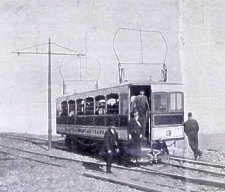
Car on line showing brake.
The brake which is so successfully used on the Snaefell Railway is a form of toggle joint, the horizontal motion which gives the gripping property the brake being obtained from a hand wheel and vertical spindle which is worked by the driver, There is naturally a good deal of surface wearing on the brakes, but they are designed to stand a good deal before requiring to be renewed. While on the subject of the outside construction, we might mention one or two facts concerning the electrical part of it.
It is scarcely necessary to say that the cars derive the electric energy from overhead wires, a slight modification of the well-known Hopkinson collector being employed. The modification consists in making the top part of the rectangle rigid, but we will speak of this when we come to consider the rolling stock in detail. The overhead mare consist of No. 3 B.W.G. hard drawn copper wires, which are held by insulators which in turn are supported in clips attached to cross arms on steel poles ; the return circuit is through the rails, which _are mechanically and electrically bonded. The line is divided into two sections, the voltage employed being 500. At the present moment feeders are not used, though when the traffic has grown sufficiently to demand a more frequent service of cars, they will be laid down. We ought to mention one remarkable thing about the erection of the overhead wires, and that is the incredibly short time that was taken to put them in position. It must be remembered that there are practically 10 miles of wires; yet these, with the necessary poles, were erected in eight days, a truly record performances. If Mr Willis (who is the resident engineer for Messrs. Mather and Platt) has done nothing but this, he would deserve one's hearty commendation; but we shall have oooasion to mention other work which was carried out by him with equal rapidity.
Before going further, we will speak of the generating machinery. We have already said that a generating station is situate half way up the line. It is no doubt admirably situated with regard to the electrical conditions of tne line, but to get the necessary machinery up to such a height was a task of the greatest difficulty. There was only one way of bringing the boilers and engines within measurable distance of the generating station, and that was to haul them up an existing mountain road by means of traction engines to a point above the generating station, and then let them gradually down the hill side. In spite of these exceptional difficulties, the machinery was in situ in about a fortnight\u2019s time. Such work could only have been done as the result of the most untiring energy, and Mr. Willis had, during the latter days of the construction, an experience that does not often fall to the lot of the electrical engineer. Several nights were spent on the mountain by Mr. Willis, a few hours sleep being obtained in the wooden huts provided for the men, and alternately in the engine house.
The plant at present erected consists of four Galloway boilers, 6 feet 6 inches diameter and 26 feet long, giving a steam pressure of 130 lbs. In the engine room there are five Mather and Platt horizontal compound engines, each indicating 120 H.P. These drive, by ropes and jockey pulleys, five Mather & Platt dynamos each of an ouput of 550 volts and 120 amperes, when running at a speed of 900 revolutions. The leands from each dynamo are taken to a separate panel on the switchboard, and thence through a lightning arrester to the line wire. The engine room presents an exceedingly neat appearance, the steam pipes having been carried underneath the foor in of the station. There is, however, nothing much about the power plant that calls for special comment; it is of a solid useful type, and quite adequate to meet the heavy demands that occasionally arises.
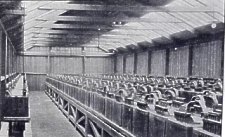
Accumulator Room
The success that has undoubtedly marked the use of the chloride accumulator on the Douglas and Laxey line has led to the adoption of this type on the Mountain railway, The accumulator room, an interior view of which we give, is situate at the foot of the mountain, quite near in fact, to the starting point. It is a roomy and light building, in which are placed 246 accumulators of the patent protected type ; they have an output of 176 amperes for 3 hours, 112 for six hours, 84 for nine, and 72 for 12, They are charged by the surplus current from the machines, and discharge in parallel with the machines as the variation in the demand for ourrent requires.
Although the cars are of quite a new type, there is nothing save the arrangement of motors, to mark a difference between them and the cars on the Douglas and Laxey line They are of the open type, and are designed to carry 50 people, including the driver and conductor. Each car is fitted with four series motors, similar in design to those used on the Douglas and Laxey line, The cars are carried on two bogies, The motors are geared with single reduction steel gearing, and fitted with carbon brushes, the working parts being adequately protected in a box arrangement. A controller switch is provided at either end of the car, so that the car can be driven either way. Each controller is provided with an interlocking arrangement which prevents reversal of a car when current is on. The total horse-power of the car motors is 100 H.P., the car having a tractive foree of 3,500 lbs. A sanding arrangement is provided with each car, which is under the control of the driver. We have already spoken of the horizontal wheels which are carried underneath the car for the purpose of engaging on the centre rail as well as the braking arrangement. There are six cars in use at the present moment. It will be seen from the horse-power required by each car that considerable expenditure of energy is necessary to drive the car to the summit of the mountain. There is little fear, however, that the line will not be a paying one, for though the line has not been opened more than a few weeks it has already become exceedingly popular with the visitor. The fare charged to the summit of the mountain and back is 2s., and when we mention that on one day during our visit 900 passengers made the ascent, it would not be rash to prophesy a prosperous career for the new line.
It takes about 27 minutes to ascend the mountain, which gives a rate of travelling of nearly 12 miles an hour, and this when the car is full.
The point which struck us as of supreme interest was the ease with which the cars at all times took the gradients of 1 in 12. We are quite aware that ordinary adhesion methods ought to do something equivalent to this, but when such a gradient continues for nearly five miles, it must constitute a very severe test.
The completion and the successful working of the first mountain railway by electricity will, we think, be of immense importance, especially when considered in conjunction with the light railway problem. It would be perfectly easy to tap isolated neighbourhoods by means of a line similar to the one at Snaefell. Its construction would cost very little more than a steam road, while the working expenses would be much lower. The total cost of the Snaefell line—and one has to consider the natural difficulties that existed—does not much exceed £40,000. Such a sum would go a long way towards laying down a line over a country which was not mountainous.
As we have already pointed out, the line is merely intended for pleasure purposes, and will lie idle during the winter months, There is little prospect of obtaining winter traffic even if the line were extended. It is reasonable to suppose that the coming winter may cause some considerable expenditure in getting the line into working condition for next season, but save on the overhead lines there should not be over much deterioration.
|
|
||
![[Manx Note Book]](../../mnb.gif)
|

|
|
|
|
||
| Any comments, errors or omissions gratefully received The
Editor HTML Transcription © F.Coakley , 2026 |
||