James McCrone 1767-1840
|
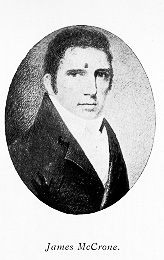
|
"Mr. McCrone came from Glasgow to Douglas in 1817, bringing with him
his young wife, the daughter of a famous London minister. He lived first
at Castle Mona and afterwards
at Rock Villa, a handsome
house a little further north. The site is now covered by
large boarding houses. His name is perpetuated in "McCrone's Slip"
nearby. Later he bought and farmed Ballaquinney, in Marown parish."
Originally an agent for both the Duke
of Athol and for Bishop Murray,
a scion of the ducal house. Post the Crown purchase of the Ducal estate
in 1828 he was appointedCrown
Agent Died in May 1840 a few days after a serious injury when a young
horse bolted throwing him, a young daughter and a servant out of the carriage
against the sea wall whilst returning from church.
In 1825 founded the Presbyterian
Church in Douglas (now St Andrews). Much disliked by the native Manx
for his part in the tax and tithe gathering by the Duke of Athol and his
nephew the Bishop. David Craine in his article on the Potato Riots of
1825 [Proc IoMNHAS vol IV no IV p570] describes him as "a hard
and unsympathetic Scot". Thomas Kelly invokes
his name with scorn.
|
He arrived on the Island in his early 50's, with his newly married and much
younger second wife, possibly escaping financial problems back in Scotland -
for his background I'm indebted to Dr Stuart Nisbet who encountered McCrone
whilst researching the coal and limestone mining around Glasgow and describes
him as "perhaps a typical example of a chancer who pushed things to the
limit and ended up bankrupt at least once, but recovered. In other words an
interesting character! His later life seems to attest to his bolshie nature".
James McCrone was born in Cumnock, Ayrshire to Hugh McCrone and Janet Timpony
(various spellings) and baptised on 5th October 1766. He was the eldest of
at least four siblings, Jean, Hugh, George & Penelope. His father was
a shoemaker.
Cumnock was an early mining area, and although James latterly speculated
in banking and property, mining was his speciality, and the early source of
his capital. By the 1790s he had moved to Kilsyth Parish, 17km north of Glasgow,
in Stirlingshire. Coal and limestone mining had flourished there, especially
with the opening of the adjacent Forth & Clyde Canal in 1790. He formed
James McCrone and company, based in Queenzieburn, Kilsyth Parish, Stirlingshire.
James acquired mineral fields and land, where he exploited the local coal
and limestone. He was also a pioneer of early horse-drawn waggonways, to carry
the minerals to the canal, and on to Glasgow and Edinburgh.
However James always operated on the edge of solvency and James McCrone and
Company were declared bankrupt in February 1794.
James moved his business base to High Street, then Trongate in Glasgow. He
also acquired property in Gallow Knowe, Gorbals, south of the Clyde, another
early mining area. From c.1809 also began building up an estate of c.50 acres
at Holmhead/Braehead in Cathcart Parish, also south of Glasgow. The estate
was surrounded by lime and coal workings and James opened coal pits there.
Again he was active in the transport of minerals and protested about toll
charges.
He continued to speculate in land and banking and was agent for the Stirling
Merchant Bank.
James McCrone ('merchant') was married twice, first to Catherine Dillon in
Glasgow in 1794. She died on the 4th Dec 1814 at their house at Gallowknow,
Gorbals. No known children of that marriage.
On 7th September 1817, aged 51, James married Margaret Fletcher in Dunblane,
Stirlingshire (also registered in Gorbals on 13 September). They were married
by her brother, Alexander Fletcher, a minister. However two months later the
Stirling Bank folded with large debts. In 1827 James disappeared from the
Glasgow Directories. He was still recorded as the owner of Holmead, Cathcart,
which he let to others through the 1830s.
In Glasgow Directories (1801-25) McCrone is described as 'agent/messenger.'
He is also described once as 'auctioneer.' At the bankruptcy of the Stirling
bank in 1817 he was the company 'agent' in Glasgow. He was also described
as 'messenger' when he was presented with a silver award for revealing a £15,000
fraud against the bank in 1805, so agent/messenger were interchangeable.
He may even have gone beyond this role as some sort of investigator/detective.
In a House of Commons discussion re the window Tax on 3 April 1817, Jas McCrone
was noted as giving representations to the Barons of Exchequer of Scotland,
so beyond his other interests, clearly seems to have been a Scottish tax/customs
officer.
His first appearance in the Athol Papers was in a
letter from Bishop Murray to the Duke in which the young Bishop seems much
struck by McCrone and recommends him to his uncle the Duke. The bishop appears
to rely very heavily of the claimed intimate friendship of Wm Scott and McCrone
but McCrone only arrived the day before Scott's, admittedly sudden, death -
possibly Scott had told McCrone of the need by the Bishop for a suitable replacement
for the recently dismissed previous tithe agent Radcliff (who was accused of
cheating the Bishop), or was McCrone a plausible talker - but either way McCrone
was within days of his arrival in a high profile job on the Island. Subsequent
letters show the Bishop praising McCrone to the Duke so the Duke also employs
him and his wife as live-in caretakers of Castle Mona and then in more significant
roles; being a Scot meant he was trusted more by the Murrays than the native
Manx who were growing unhappy with the Murray family and their nespotic appointments.
Within a couple of years he was involved a a trial for perjury from which he
was acquitted - possibly based on a misunderstanding, it would appear to have
been brought by the opponents of the Duke and Bishop in an attempt to remove
him from the post - see Roper's A
Short History for a very partial account.
He was a key agent for Bishop Murray and the Duke until the Duke's death, playing
a key role in the valuation of the Ducal property and after the purchase by
the Crown being appointed as Crown agent where one task was to dispose of the
property to the advantage of the Crown - a task he would appear to have done
well and honestly though not all
his suggestions were acted on. His
Letter Books whilst in this role are held by the Manx Museum.
As mentioned James McCrone married Margaret Fletcher in September 1817 - several
children born on Island :
Marian Fletcher McCrone Christening: 30 Jan 1819 Saint George (later married
John Wilson 12 Sep 1841 Gorbals, Lanark)
Janet McCrone Christening: 25 Jun 1820 Saint George (later married William
Jones 12 Jul 1846 Largs, Ayr)
Jane Gilfillan McCrone Christening: 27 Jul 1821 Saint George (later married
David Buchan Douie : 9 Feb 1850 Largs, Ayr)
Jemima McCrone Christening: 15 Feb 1825 Saint George d. 1836)
Died from his injuries a week after his horse bolted and threw him, his daughter
and a servant out of the carriage and violently against the sea-wall
Manx Sun, Friday, 22nd May 1840
We regret to report a very serious accident which occurred to Mr. Mc.Crone's
family on Sunday morning last. They had as usual attended divine worship at
the Scotch Church, and on returning in their car, drawn by a halfbroken horse,
the animal ran away near Mr. Duff's, at Marina, and on turning the corner
upset the car with great violence, by which Miss Mc.Crone was severely injured
on the head, Mr. Mc.Crone had his collar broken, and the servant his arm and
two ribs. Fortunately Mrs. Mc.Crone refused to take a seat in the car, not
having confidence in the horse. Mr. Wm. Duff, who witnessed the calamity,
had the whole of the sufferers removed to his house, where they still remain,
and although doing well, are not sufficiently recovered to bear removal to
their home.
Manks Advertiser, Tuesday, 26th May 1840
In our last we announced an accident which had befallen Mr. Mc. Crone, and
part of his family, on their return from the Scotch Kirk, on the Sunday previous,
and we have this day the painful task of recording the death of Mr. Mc.Crone,
which took place at half-past two o'clock, on Sunday morning, in the house
of Wm, Duff, Esq, Mr. McCrone was in the 74th year of his age. This gentleman's
death will be deeply regretted by all who had the pleasure of his acquaintance.
He was a native of Scotland, but had long resided upon this Island. We should
be happy to be able to report favourably of Miss Mc.Crone, but we regret to
say, she still remains in a very precarious state.
A most solemn and deeply affecting sermon, on the death of Mr. Mc.Crone,
was preached in the Scotch Kirk, in this town, on the morning of Sunday last,
by the Reverend Mr. Ralph, of Liverpool, who very kindly officiated for the
Reverend Mr. Maclean, who has been so deeply affected since the sad catastrophe
took place, as to be unable to perform public duty. During the discourse,
the Rev. gentleman stated that this was the third time he had occupied that
pulpit ; he preached a sermon at the opening of that place of worship ; secondly,
be assisted their beloved pastor, in the office of Communion ; and this, the
third time he had the painful task of preaching a sermon on the death of his
much esteemed friend. Mr. Mc.Crone, The Rev. W. Carpenter also delivered a
very affecting discourse on the death of the above respected gentleman, and
pointed out the: uncertainty of human life ; and strongly urged his auditors
to prepare themselves for a future state, as they knew not at what hour they
might be called to render an account of their transgressions. How deeply affecting
was the discourse of the rev .gentleman, that every eye of his congregation
was moistened with tears.
Buried in Onchan Churchyard, beside his youngest daughter, Jemina, who died
April 7th 1836, aged eleven years. The gravestone bears the following inscription;
"Sacred to the Memory of JAMES McCRONE, Esq., Crown Agent in this Island
for above fourteen years, the duties of which office he performed with great
fidelity. Gifted with a powerful mind, he pursued the business of life with
energy and success, whilst by the warmth of his heart he endeared himself
to his family and friends. He died with a hope full of Immortality, 24th May,
1840, aged 73 Years."
There were three of Mr. McCrone's grandsons still living in 1925, namely :-
Sir James McCrone Douie, K.C.S.I. the son of the Rev. Mr. Douie, Free Church
minister of Largs, Ayrshire. He had a brilliant University career, and passed
very high in the Indian Civil Service qualifying examination. Eventually he
rose to the position of Chief Financial Commissioner of the Punjab. For some
time he had the honour of being Acting Governor of that important province.
At the famous Delhi Durbar, he was Knighted by His Majesty. When his official
life closed, he returned to this country, and made his home at Oxford.
Mr. T. M. Greer is the son of Mr. S. M. Greer, who was County Court judge
of Cavan and Leitrim, and sometime Member of Parliament for Co. Londonderry.
Mr.T.M.Greer is a graduate, and medallist, of Trinity College, Dublin, and
was admitted a solicitor in 1876. He holds a leading position in his profession,
and is a Deputy-Lieutenant of Co. Antrim. In the religious sphere he is an
elder of the Irish Presbyterian Church, and convener of the Assembly's Committee
on Tenures and Trusts, which corresponds to our Law and Historical Documents
Committee. Mr. Greer was appointed to the Senate on the establishment of the
Parliament of Northern Ireland.
Mr. Jones, another grandson, lives in Australia.
Several grand-daughters of Mr. McCrone are still living. One of these, Miss
Douie, who is a member of our church at Hampstead, London, presented Mr. McCrone's
portrait to the congregation, and one or two interesting letters written by
him.
Extracts taken from History
of Presbyterianism, 1925.
Something of his political views may be seen in some of the official letters
sent back to his employers in London - that dated 17 Apr 1835 [Letter
Bk 2 MS09181C] - one discussing Courts Baron reads:
"I beg to send you, one of the Insular News papers, by which you will
see, we have warefare here as well as on your side of the water - the affairs
of the Island are very much under the control of a junto, and the Clerk of
the Rolls, the acting Attorney General and the Water Bailiff his brother are
at the head of the ruling party. The latter is Receiver General and as such,
is the first Commisr of Harbours, and being also Water Bailiff has to sit
in judgment on his own actings and doings - He is likewise Clerk of the Council,
and as Receiver General is a member of Council" - he continues with a
note of the collusion between the Water Bailiff and his brother the acting
Attorney General to prevent publication of the notice calling a Courts Baron
and continues "We need reform here, as well as in England, but I have
only one course and one object to persue, and that is to do my duty as far
and as fairly as my judgment goes, so that the Crown may not suffer under
my agency".
His widow had removed to Largs, probably by May 1842 with Rock Villa (the family
home) being sold to the then tenant in 1846. His daughter Janet was married
in Largs in July 1846 - Nisbet comments that "The family may have had an
additional house there for many years - it was a very common location for Glasgow
merchants to have a 'summer house.'"
Rock Villa, was first put up for sale or rent in August 1841, two of the carriages
had been sold a little earlier - the advertisements continued into 1842 - the
one first appearing in April 1842 being the most informative:
Manks Advertiser, Tuesday, 26th April 1842;
Desirable MARINE RESIDENCE. ROCK VILLA.
TO BE SOLD, or LET, Furnished or Unfurnished, in the Isle of Man, ROCK VILLA,
a recently built and well finished Mansion, in the Elizabethan Style, beautifully
situated on the Margin of Douglas Bay. The Grounds surrounding it are tastefully
laid out, and a romantic Waterfall is within a few Yards of the Drawing-room
Windows. The House contains a large Drawing-room, a Dining-room, with Anteroom
; Library; four large and three smaller Bed-rooms, with three Dressing rooms,
all of which are constantly supplied with hot and cold water; Servants Apartments;
Hot, Cold, and Shower Baths ; Store-rooms; Kitchen, in which is an excellent
Range; Scullery, Butler's Pantry, Meat Ditto, Wash-house, and Laundry, with
very superior Wine and Beer Cellars; an excellent three stall Stable, with
Hay-loft above; a Coach-house, Harness-room, and every Convenience, Garden,
and good Servant's House. For Particulars, apply to SAMUEL HARRIS, Jun. Esq.
Advocate; or to the Proprietor, on the Premises. Rock Villa, April 20, 1842;
The name Rock Villa reflects it location at the entrance into a small quarry
- the waterfall was probably down the wall of the quarry. The availability of
the proprietor would suggest that Mrs McCrone was still resident at the time
- two months later the contents of the "very superior wine cellar"
were put up for auction.
Manks Advertiser, Tuesday, 28th June 1842
Valuable WINES and SPIRITS.
TO be SOLD, by PUBLIC AUCTION, on FRIDAY, the 8th of July next, at 12 o'Clock,
Noon, at the British Hotel Assembly Room,—The Whole of the valuable STOCK
of WINE and SPIRITS, in Bottle, consisting of 240 Dozen, the Property of,
and imported by, the late J. M'CRONE , Esq. Rock Villa,including Very Old
PORT, Superior SHERRY, CLARET, MADEIRA, HOCK, BRANDY, RUM, GENEVA. The above
are all of the most superior Qualities, and will be sold in Lots, to suit
Families. Apply to SAML. HARRIS, Jun. Douglas, June 28, 1842. Advocate
It is probably around this period that Mrs McCrone and daughters left the Island
as the house was later noted as occupied by Colonel Taubman and family - the
advertisements for sale or rental furnished re-appeared noting its availability
from 11th May 1844
She sold Rock Villa in 1846 [SSS Oct 1846 26]
dated 6 May 1846; Mrs Margaret McCrone(at present Largs Scotland but prev
Rock Villa, Onchan) sells for £2625(Brit) to Rev Rowland Egerton Warburton(Onchan)
that capital mansion known as Rock Villa at Crescent(Onchan) + gardens, pleasure
ground etc, bounded on SW by John Stanway Jackson, on west by sd J S Jackson
+ G W Dumbell, on NE by Richard Simpson and on east by highway Douglas to
Ramsey, at present in occp of sd Rev Warburton as tenant subject to same condition
(exc ground rent) as in deed dated 12 Nov 1834 enrolled [bk 3 Onc May 1839
122?](also by deed dated 12 Jul 1838 executed by Sir Wm Hillary as truestees
of pt of Falcon Cliff); Witt J M Greer, J Higginson;
On the same day she sold [SSS Oct 1846 88] any interest in Mount
Strange that James had licenced for reasons still to be determined:
dated 6 May 1846; Mrs Margaret McCrone(at present Largs Scotland but prev
Rock Villa, Onchan) widow of late James McCrone sells for £18 10s(Ster)
to John Taubman Goldie-Taubman any + all right she may have to Mount Strange
in Malew containing 2r + 18sq yrds that James McCrone became entitled unto
by virtue of a certain licence from Commrs of Woods + Forests; Wit S M Greer,
J Higginson
She was buried in Greenock New Cemetery - the abbreviated record of the M.I.
notes "Jas McCrone esq. of Rock Villa, Isle of Man, w[idow]. Marg Fletcher
12.11.1781 - 20.11.1847, dau. Jessie 28.2.1820 - 14.2.1858 (husband Wm. Jones
Esq.)
