Report on the treatment of civil prisoners at Knockaloe, Isle of Man, England.
The undersigned came with the last batch of civil prisoners released as permanently unfit for military service. He arrived at Goch on the 9th of this month (Decembe, 1915), and has since been at Hofheim (Taunus) 6 Kurhausstrasse.
He faithfully promised his fellow prisoners to make a complete report to the [German] Foreign Office over the conditions and failings of the Knockaloe Camp. This promise he fulfils as quickly as possible by means of the following report based upon strict truth and exaggerating neither good nor evil.
I, Ferdinand Schoelles, born on the 2nd October, 1867, at Frankfurt af Maine, resident before the war in London at 21 Nassington Road, Hampstead, N.W., interned in the morning of 1st June, 1915, as civil prisoner of war at Stratford and then at Knockaloe, depose as follows:-
A policemen in plain clothes ordered me and several other Germans who lived in the same neighbourhood on the evening of the 21st May to report ourselves next morning at the Police Station Albany Street, W. whence we were transported in a light furniture van, 10 in number, accompanied by 6 policemen in plain clothes, to the Concentration Camp at Stratford. The Camp is situate in a very ordinary (inferior ?) district. It is surrounded by manufactories and workmen's houses, and visitors, especially of the female sex, to relations who are interned there are exposed to insults of the most brutal character.
When one arrives at Stratford inviduals are identified and the luggage is examined. A sergeant ("the fat sergeant" who was already a bitter memory to many an interned man since the time of Olympia) occupies himself in making prisoners properly respectful by the grossest rudeness and actual physical measures such as boxes on the ear, blows on the breast, and treading on people's toes; curses also and insults. This same sergeant when he is inside the Camp far removed from the eye of his officers is a very tolerable individual; a fact which produces in the mind of the prisoners the firm conviction that his brutalities are practised by the wishes of his superiors.
We were 14 days in Stratford; we slept upon straw mattresses in a complete confusion of social ranks and ages. People arrived in the afternoon and were brought before the Doctor next morning. His investigation was so ridiculously superficial that it caused universal contempt. On the other hand the conditions as to food and washing at Stratford, and also the possibilities of making purchases at the Canteen were good.
The removal from Stratford to Knockaloe took place as far as I can remember in the morning of the 14th June. About 500 of our people were after breakfast taken from the Camp to the Station about 8 minutes distance through the streets which were full of people, and we were again exposed to the insults of the mob. Each one of us had a piece of bread with some meat as provision for the way. We were placed in through-carriages quite comfortably, 6 men to a carriage. In the corridors were soldiers loaded carbines.
The train started at 10 and arrived at 5 o'clock in the afternoon at the harbour of Fleetwood. On the whole journey we could get no refreshment or food even for money. At Crewe we had one cup of water apiece taken from a pail. At Fleetwood we embarked. The greater part of the ship, including first-class, was for officers and escort, The small after-deck and hold which stank horribly of fish was destined for the 500 prisoners. No trace of food even for money. A protest by deputation had no success; the officer simply said he had no instructions. We could get a cup of bad tea on board ship for 3d and that was all.
The ship sailed at 11 o'olook at night. The air below deck was bad and the night cold, and so the greater part of us stopped without proper protection or any seating accommodation most uncomfortably on deck.
We arrived at Peel about 6 o'olock in the morning. We were drawn up on the Quay, counted, and then after a halt of about an hour we were marched to Knookaloe Camp. It took us about ¾ hour, When we arrived at the Compound we were again counted, we had to support an address from the Commandant, and at last got our first meal for 24 hours and a good rest. A few of the older men were made ill by their hardships, and two died soon afterwards.
In the Camp we were assigned to Camp 2, Compound 2. I must give in detail the arrangement of the Camp.
I will only remark first that at our arrival the latrines had not been furnished with water supply. In the interval a temporary erection had been put up which the wit of the prisoners called the "Dardenelles".
The men were compelled, with what were often very ineffective foot gear, to cross several times a day the 50 yards of space between the huts and the "Dardanelles" and had to make their arrangements in streaming rain without any roof. There was also a complete deficiency of washing arrangements in the beginning; the washing and drying rooms were not yet ready when we came in and we were compelled in all weathers to wash ourselves in pails in the open air. Hot or warm water there was none. These conditions lasted for five weeks. What followed was not very much better.
The latrines were at last ready for use, but even these permanent erections have no roofs, only the seats are covered at the sides and at the top. The passage down the middle has no roof over; the rain streams in and the wind blows from all sides. The rain water stands in the gangway and has to be swept out with brooms. Moreover the place is flushed only twice in the day. Those who have not spectacles are made almost sick by the appearance of the latrines and there is usually a horrible smell.
As to the washing arrangements two pails are provided by the English Government for every 30 prisoners which have to serve for the personal washing and washing up dishes, though for washing up there is in addition a small tub of galvanized iron for every 30 men. The prisoners who have means bought pails at 1 mark 50 each for their private use and several prisoners paid to have their washing done. The others had to arrange as best they could. Personal washing had to be done between 7 and 8.30 in the morning which was also the time for breakfast, and the space allowed is so small that there was an allowance of only 0.070 square metres of surface for each of the 900 prisoners, in the Compound. Naturally not all of them came to wash and several never washed at all. Full size baths are only to be had in hospital. We had to content ourselves with douches which were of very cheap quality. The hot water often gave out, or was only in insufficient quantities. The floor was cemented; the room haa no seats on the walls and no planks on the ground. People had to stand on the cold, wet and not too clean cement. Pails were upset and wetted clothes and trousers.
A little before my departure six douches were working; the others had been screwed off. It is astonishing that on an Island where it rains almost unceasingly there should be such a want of water. For 2 weeks it was so bad that we had to provide ourselves with water by Compounds. From 5 o'clock in the morning till mid-day one compound after another came to the water supply and during this time most of the prisoners paid only a theoretical attention to their bodily cleanliness.
The flushing of the latrines also was interrupted for 14 days; the old system with pails was again used. As to housing conditions, the [German] Foreign Office are well aware that the Knockaloe camp is divided into compounds, of which 5 go to a camp. Of these camps there are now 5[sic 4]. Each compound has from 900 to 1000 inmates. 5 compounds make a camp, that is 4500 to 5000 prisoners. Each separate Camp has a Sub-Commandent (our camp was under Major Fyfe Scott). The Sub-Commandent has an Adjutant also,a Medical Officer for daily consultation and one other for Hospital inspection. The Compound has one Sergeant who looks after intercourse with the outside world and every hut (there are 12 of them) has a German Captain and these Captains have elected a Head Captain.
The huts are defective in construction, of single match boardings with no upper ventilation and the fresh air can only come in through the windows and doors. The walls show leaks and gaps. According to the direction of the wind, part of the huts is exposed to bad weather and as the climate of the isle is the worst conceivable (it rained. in summer often for 24 or 36 hours without interruption and there was frequently a strong wind blowing) and so wet and cold penetrated into these huts on all sides. The walls and floor never get rid of the damp and there are constant cases of colds. People suffer with rheumatism who formerly were quite healthy, The climate appears to have been especially bad for the asthmatic and people with weak hearts. On the 1st December in our compound 145 men were sleeping on Government testle-beds, 220 on beds they had made themselves or paid for and 584 on straw palliasses on the floor, total 951 men The Government has now distributed more testle-beds, but many are still in arrears. I slept for a whole six months of my internment on a straw mattress. The Government gave out no pillows and at the beginning only two blankets. In the middle of October a third blanket was added, thus there are three blankets altogether, not of especially good quality or weight, In the hut there were 8.17 cubic metres space per man. In these huts men slept, and eat, worked, smoked and played. In October every compound was given a Hall which was used for eating but was then found unsuited for this purpose. The Halls are now used for Church services and for recreation and instruction purposes.
On the 1st December, after months of pressure, the first stoves arrived. These were set up as shown on the following drawing :-
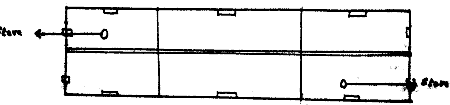
In a double hut with three sections and connecting doors such a stove has a heating service of 0.014 square metres per individual, in other words completely insufficient. Since the cold weather began the English Government gave us 25 per-cent less coals for cooking in order to make up for the extra amount of coal that was wanted for the supplies in the huts. More stoves were promised, but everything on the isle takes a long time, so no great confidence in the promise is felt. It is true that electric lamps are there, but the current is too weak. In the evening you can only read if you sit close under the light. The light is turned off at 10 in the evening, The prisoners are called [wakened] about 7 in the morning. The ground in the neighbourhood is clay. The courts of the compounds are, after rain, a great morass. Asphalted paths to the kitchen and the wash-house would be desirable. Up to present only railway sleepers have been put down which get slippery in the wet and have caused many falls.
As to clothing, the English Government distribute only trousers, coats, shirts, socks and heavy wooden shoes with upper leathers of defective quality. A man who receives a pair of trousers has to give up his old pair so that most prisoners have only one pair each, They cannot change in wet weather or dirty work. Underclothes were not given out. Private charity on the part of Germans provided as much as 700 marks in one compound alone for underclothes. There are no overcoats.
As to food, the rations appointed by the English Government are well known over here, and I also have a very clear recollection of them. At the commencement of my internment the provisioning of prisoners at Knockaloe camp was left to a contractor whose deliveries, at any rate for the prisoners, were very unprofitable and provoked general complaints. The crisis came when three Sundays in succession, instead of the beef which was due to us, was provided a kind of dried salmon of Canadian origin. This fish was absolutely uneatable. The bolder spirits who eat of it fell ill, the others had to content themselves on these days with potatoes and bread. An announcement from the Commandant followed that the prisoners for the future must take their own commissiariat in hand. The Government provided materials and gave a small addition of pay to the prisoners employed in the kitchen. The Prisoners collected a certain sum to improve the food and since then, things are better, but complaint is still made that no husk vegetables such as beans, peas and so on can be had. Frozen meat, which is alone supplied, is often not altogether reliable, but apart from this there is not so much to complain of in the food. The kitchen supplies cakes, biscuits, baked bread and so on at a penny a piece These things are great favourites and soften the monotony of the regular ration. A few weeks ago the Conmandant, at inspection, went through the kitchen and saw the appetising baked bread [confectionary] which caused him to remark:- "Our people in Germany don't get such stuff as that". The people of our Kitchen Committee answered :- "It is the people's own money and our own good organisation."
Washing of clothes. Apart from the want of space and water, I ought also to remark that the clothes can, under no conditions, be boiled. The Canteen, which is in every compound, supplies jam, matches, tobacco, biscuits and a small choice of things in boxes [tins]. It is scantily provided and the things are very dear and it is managed very scrappily. There are no clothes or boots to be got. As the Government itself does not sell these things, prisoners who have no friends outside cannot supplement their wardrobe. Money cannot be sent out of the camp to shops in England to get supplies from these sources.
Interned prisoners have very little opportunity of work. Some of them are invited to do field work outside the camp for which they receive 3d a day. They only went for the sake of change. The Commandant invited the prisoners to take sewing for the post bags on payment of 1/- a sack. (such a sack cannot be sewn in less than two days). For the present 20,000 sacks were ordered. There were to be 25,000 more. The prisoners suspected that these were not mail bags, but cement or sand bags intended to serve as defences, which they were tried to make to sell and they refused with very few exceptions. The Commandant wes very angry and announced that the men were prisoners of war and that, as such he would compel them to work and threatened to withhold percels if the work was not done, The quarrel had not been settled when I left.
Medical help. Doctors are not there in sufficient numbers. There is a deficiency in drugs and surgical instruments, The hospitals are defective in construction and do not make a pleasant or clean impression. A man who was suffering from injury to the bladder had to lie in the cold for weeks together on the verandah of the Isolation Hospital because there was no room inside. He had a hole in his body through which the contents of the bladder escaped. The india-rubber bottle which was intended for his use was broken and the contents of the bladder escaped into the bed and into the linen. Still he had to lie there. A prisoner of the name of Strick, who, in the interests of his fellow prisoners reported the matter and similar defects was sentenced to six months imprisonment. The invalid himself was sent over here on the occasion of the last exchange of prisoners and is now in Germany. One of the doctors, called Kitchen, was generally drunk, another, Simms or Syms under- took small investigations and operations with his pipe in his mouth. Not a single one of the doctors was up to his work.
In the beginning of December appeared a leading article in the London Morning Post with the title "Dirty fighters" which raised general discussion [disgust] in the camp. In this article which no doubt is known over here, the enviable position of prisoners in England was contrasted with the sad condition of Englishmen in German hands. The article, so far as related to our position and treatment was full of lies and exeggerations We felt bound to send to the American Embassy a protest in which we called attention to the untruths and asked the Embassy to put the matter right in the Morning Post. This letter was was sent to the Embassy on the 7th Decenber. When I left no acknowledgement had been received and the same was true of a longer letter on the 23rd November in which we pressed for the correction of several crying abuses, especially the defective heating of the huts.

