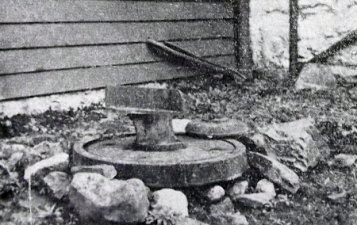
Fig 1 Driving unit of the Ballaquinney churn-walk.
Now preserved in the Manx Museum through the kindness of Messrs. Cowin Bros.
W. CLARKE Technical Assistant, Manx Museum and National Trust
During the course of a year, many interesting objects are brought to the Manx Museum, or are brought to the notice of the Museum staff. Many are quite important finds, while others, though of minor value invariably reveal some interesting information which when pieced together adds still further to the picture we already have of the ways of life in our Island through the ages. It was with this thought in mind that a visit was paid to Messrs. Cowin Bros.' farm at Ballaquinney, Marown, after a report had been received of the existence there of a churn walk.
Fig 1 Driving unit of the Ballaquinney churn-walk.
Now preserved in the Manx Museum through the kindness of Messrs. Cowin Bros.
A churn walk is the name given to the site of a horse-driven churn. This site, usually a little patch of ground at the side or the gable end of the dairy, consists of a unit of cast iron cog wheels set into the ground (Fig. 1) from which comes a shaft or spindle, which in turn passes through the wall into the dairy and with suitably geared cog wheels and chains, or in some cases a belt, is connected to the churn. Mounted on top of the outside unit is the driving shaft, to which a wooden beam about six or eight feet long is bolted. A horse is harnessed to the beam, and driven round in much the same fashion as at a horse mill; this turns the spindle which transmits the drive through the wall finally turning the churn, in this casea barrel churn with baffles fitted inside, so that the whole thing revolved.
The discovery of one such churn-walk led to others, and up to date seven of these sites are known, while many more must surely exist. One is said to have existed on the Calf of Man of all places, and besides that at Ballaquinney there were others at Ballacharrey (Malew) at Eairystane (Arbory) and at Ballacreggey (Michael). Very little is left at Earystane, though one can still see the curved wall which formed the outer portion of the circle round which the horse walked.
Again, at Ballacharrey very little remains of the original site, but Mrs Kinvig, the wife of the farmer there, remembers well the churn- walk in use. She described to me the large box churn — now replaced by a more modern, and much smaller, end-over-end churn — which could take two crocks of bithag and could produce forty-two pounds of butter, and smiled when telling of how something would induce the horse to move faster than usual, then the flyers or paddles would whirl, the lid would come off and the butter would be plastered all over the dairy ceiling. Then on the other hand, if a suitable watch was not kept on the horse it would stop to crop the grass, and there would be no butter at all!
Chance remarks are quite often the source of interesting finds and so it was in this case. While searching for information on the horse-driven churns, mention was made of yet another type, a water-driven one. This was run to earth up at the Moaney Mooar (Malew) and proved quite fascinating and ingenious in construction It also showed how by dint of hard work and more than a little ingenuity the upland farmer could direct the natural resources of his surroundings into a useful source of power.
Unfortunately, at the time of the year when I visited this site the trees were in full foliage, the grass high, and the bracken thick, which made it difficult to see what remained of the churn-walk, but it was possible to get an idea of the method employed.
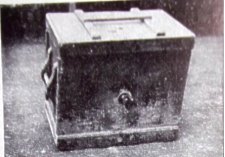
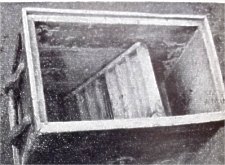
A small dam had been constructed to redirect and regulate the flow of water to turn a water wheel. This wheel supplied the driving power through an amazing series of shafts and cog wheels, both at right angles and parallel to the stream, finally connecting by a chain to the outer wall of the dairy (which was, incidentally, easily ten feet above the level of the stream) and passing through the wall into the dairy to drive the churn, which was of the box type, with flyers (smilar to the one illustrated). It is about 70 yéars since this water-driven churn was in use, and I think we can reasonably assume its working life would be from ten to twenty years at least, probably much longer, so that these mechanised aids to churning must have appeared on the Island early in the 19th century.
They were quite common in England at the beginning of the last century, and appear to have been very much larger than Manx types, which is only to be expected when one compares the acreage of the farms and the size of herds. One such churn-walk from Buckinghamshire is displayed at the Science Museum, London. It was originally designed to drive two fifty-gallon barrel churns, and it is said that in 1½ -2 hours about 250 lbs. of butter might be made in each churn. In Scotland a similar mechanical device was known as a "horse-course," capable of driving two staff churns of the plunger variety. This machine, complete with horse-wheel and gearings, cost from £15 to £18. In some parts of Ireland a similar machine was known as a "glaik," but there in place of a horse, a spring pole, much the same as a pole lathe wasthe means of propulsion.
On the Island these mechanical aids appear to have been quite common on most of the larger farms, the main reasons for their existance being that they served to free someone for another job — provided of course that a watchful eye was kept on the horse — and afforded a convenient means of employing an old animal on the verge of retirement.
The staff, or plunger-type churn seemed to have been most popular in the Island during the early 19th century, though Basil Quayle, writing in 1794 in his "General view of the Agriculture of the Isle of Man" says: "A few barrel churns are used on the larger farms, but the plunge churns are most common. Butter is the chief object as it meets with ready sale, and the milk an indispensible article in house keeping. On a few farms having from 10-20 cows, cheese making is practised, Fresh butter is sold at fivepence per pound, and in winter and spring as much as eightpence. When salted in crocks it sells at sixpence and sevenpence. Between 800 and 1,000 crocks containing 30 lbs. each are annually exported to England." This gives an idea of the important part the production of butter played in the Island during the last century, when the average output per week of the various farms was between 40 and 50 lbs.according to size, for sale locally In addition to butter making, most farms had their milk rounds, and would set off each day in the float (another fast-disappearing sight) loaded with milk, eggs and butter.
 |
 |
Most churns were made locally either by the jomer, or in the outlying districts — by the blacksmith, who some cases was also a cooper. This accounts for the variation in design, as each man had his own ideas on size and shape, etc.
The larger box churns were quite large and would take a good-sized crock-full (about five gallons) of milk. Sometimes they were large enough to hold two of these.
The staff churns, too, varied a little, mainly in size and considerable skill was needed in using them. There was quite a knack in working the plunger, and if care was not taken the contents would shoot up through the holes in the plunger and as the person churning would be bending forward over the churn at the time, the results could be either annoying or amusing depending on whether you were doing the churning or just looking on!
Quite a lot of butter was salted down each year for local use as well as for export, and here again people had their own ideas and methods. Some rubbed the salt into the butter, others simply wrapped it up and put it into the pickle. Some made it up into pound size blocks, while others preferred to salt it in the crock in a mass.
Judging by the number and variety of butterprints in the Museum collections, the various trade marks for butter were evidently an important factor. The prints differ in a great many ways: some are the roller typr, others the older press type, while a few are the more complicated box type (which worked much the same as the implement used at the present time for producing ice-cream wafers). The designs on these butter prints are beautifully carved; their makers lacked neither skill nor immagination - not to mention the patience need for carving a design in reverse. The value of the Prints lay of course in the fact they added a little interest to the finished product, much the same as many of our present-day paper wrappers do, and of course once you had found butter of a texture and taste to your palate you would naturally continue to buy the butter with the same print on it.
As in most other local industries, superstition and luck also played its part in butter-making, Even the Manx churning song takes the form of a charm rather than a song, and a horse-shoe nail driven into the bottom of the churn, or a handful of salt placed on the lid, was said to work wonders. Wrapping the butter in certain kinds of leaves, such as dock leaves, was also claimed to improve the flavour.
Very little Manx butter is made today, and it seems a great pity that what was once a thriving business has declined so quickly and now appears to be looked upon as a weekly chore.
|
|
||
|
|
||
|
|
||
|
Any comments, errors or omissions gratefully received
The Editor |
||
Driving unit of the Ballaquinney churn-walk. Now preserved in the Manx Museum through the kindness of Messrs. Cowin Bros.

![[Index]](../logo.gif)