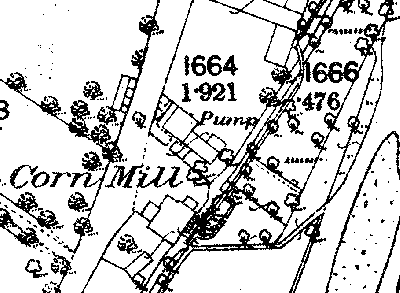
From 1868 O/S Plan IV/12 - SC 385942
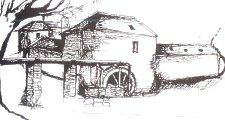
conjectured water supply to threshing mill
[taken from Cannell]
|
From 1868 O/S Plan IV/12 - SC 385942 |
|
Sue Cannell has the following description of the two mills - one a threshing mill driven originally by a turbine (later replaced by a vertical wheel) and the old corn mill rebuilt c.1840 by the new owner, Caesar Bacon, who renamed the old Ballabrooie as Staward after his property in Northumberland
Bacon made use of the Sulby River draining the mountain nearby and built a mwyllin bwoallee (threshing mill) in addition to the existing mwyllin aaroo (corn mill). Water was initially brought along a raised earth bank to the now-ruined corn mill.
There is still evidence of the leat which ran from the Sulby River above Ballacuberagh, via the two wheels of the nearby Southwards woollen mill [they moved in 1842 to a newly constructed mill which had 2 wheels] and thence on to Staward, a not-uncommon example in the Isle of Man of the 'multi-use' of one off-shoot of water. The tail race was released through a bridge of slate slabs and above was a very large granite grinding Stone. Large stone pillars still stand and support a continuouswooden trough, which forms an aqueduct . This took the water to the threshing mill connected to the main set of farm buildings. A turbine was installed by Bacon in 1832 [? 1842] , with water leading through to the now-blocked arch near the north end of the mill.. The wheel pit and standard iron-trimmed segmental wheel appear to have been added after 1868
There is a letter published in 1848 indicating it the time it used a early turbine wheel
Kirk St. Anne, Isle of Man,
22d March, 1843.
Mr. James Whitelaw.Sir - It affords me great pleasure to be able to give the following particulars respecting the patent water-mill made by you, and which was erected by me in this island, on the estate of Ballabrooie, the property of Caesar Bacon, Esq., in the parish of Lezayre.
The mill has two arms or jets, and when both are open, is calculated to give 9½ horses' power,and is used for the purpose of driving an ordinary machine for thrashing corn —The two arms I find to be altogether too powerful, consequently I partially closed one leaving it about one-third part open - this would leave 6.33 horses' purposes: We were thrashing oats at the time, and the quality not of the best description, the straw being long, and the ear not well filled. In one hour we thrashed 88 bushels of oats, Winchester measure. The grain was well cleaned, and free from chaff.
The thrashing-mill, feeding-rollers, are 4.5 feet diameter, with two shakers and one pair of fanners.
Having had a great deal of experience in setting up thrashing-mills, I can speak with some degree of certainty of the advantages of your patent water-mill in this instance, over the ordinary over shot water-wheel; and as I believe it to be the first of the kind applied to this purpose, I trust it may meet the notice of all farmers desirous of making the most of the water in thrashing, especially in dry seasons. Having made most of the thrashing-mills with water-wheels on the south part of this island, I can with truth say, I have never been able to get out of a thrashing-machine, worked by an over-shot water-wheel, having the same advantages as to height of fall and quantity of water that your machine has, more than 58 bushels of well cleaned oats per hour; the balance in favour of your mill is therefore 30 bushels per hour, or, in other words, a saving of one-third of the time ordinarily taken. You are at perfect liberty to refer any person to me for further information on the subject.—I am, Sir, your most obedient servant,
Thomas Baird.
Thomas Baird, millwright, can be found in the 1841 census, aged 25 (rounded ) with wife Mary Hodgson (m Braddan 1838) with an 18month old daughter Mary - he is absent from home in 1851 leaving 40 yr old Mary heading a house with 6 children at 1 Douglas Road Santon. From an online family tree for one of his sons it appears that he and family emigrated to the USA in the early 1850s and then movred by ox team to California in 1859 where he established a flour and grist mill in Woodland.
James Whitelaw Description of Whitelaw & Stirrat's Patent Water Mill 2nd Ed Mechanics Magazine Office London 1848
Sue Cannell Rural Architecture in the north of the Isle of Man MNH Douglas 2001
Bawden et al.The Industrial Archaeology of the Isle of Man 1972
|
|
||
|
|
 |
Water powered Mills etc |
|
|
||
|
Any comments, errors or omissions gratefully received The
Editor |
||
