 Ballamona
Hospital 1868-1968 - Centenary ProgrammeBallamona
Hospital 1868-1968 - Centenary Programme
Ballamona
Hospital 1868-1968 - Centenary ProgrammeBallamona
Hospital 1868-1968 - Centenary ProgrammeThis is a slightly edited version of the text in the Souvenir Programme as relating to the history of the hospital.
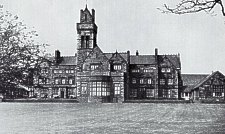
Original Hospital Building
The Ballamona Centenary Celebrations afford an opportunity to all publicly to recognise the achievements and progress in the Methods of Treatment of the Psychiatrically ill, since the Hospital was built 100 years ago.
It is appropriate that coincidental with the Centenary year, the Health Services Board have commenced large scale building of two Therapeutic and Psycho-Geriatric Wards, besides the completion of the new Junior and Adult Training Centre and its Special Care Unit.
These Celebrations, while commemorating the past, are equally important in marking the introduction of new ways and means "by which advanced psychiatric knowledge, research and treatment, can achieve through the dedicated services of Medical and Nursing staffs, the return of the patient to a full and active life in the community.
I am glad to have the opportunity of writing this brief foreword, and recommend to you a week full of interest and thought.
C. C. MCFEE, M.L.C., J.P.
Chairman of the Isle of Man Health Services Board..May, 1968.
THE MANX PEOPLE have always been kind and sympathetic and tolerant towards those members of the community who are suffering from illness, whether this illness be physical or psychiatric. At the beginning of the nineteenth century the people of the Island became very concerned about the lack of facilities for the treatment and care of the sick and disabled. Records from this period show that numerous statements were made to the Governor and members of the House of Keys, and also very strongly worded letters were written to the Manx Press concerning the lack of adequate facilities.
The Chaplain and Surgeon at the Gaol at Castle Rushen wrote to the Lieutenant Governor and Tynwald:
To His Excellency, the Honourable Charles Hope, Lieutenant Governor and the Honourable Council and Keys in Tynwald...
We the undersigned, Chaplain and Surgeon of the Gaol at Castle Rushen, humbly beg to bring under consideration of your Honourable Court, the state of the said Gaol with respect to the lunatics confined therein.
Your Honourable Court will perceive, that on the Ist July, 1858, there were eleven lunatics without fit and proper accommodation and without additional attendance.
We unhesitatingly believe, that unless steps be taken for the separation of the lunatics and criminals, some serious outbreak will take place.
We ourselves never feel safe when visiting them in their present state.
In conclusion, we draw your attention to a lunatic committed to the said gaol on the 22nd April, 1858. Did on the 26th May, 1858, commit suicide cutting his throat with a razor. This doubtless could have been prevented if proper accommodation and fit attendance had been provided.
Edward Ferrier Chaplain T. Underwood Surgeon
In the Manx Advertiser, on Thursday, 6th October, 1825, the following appeal for an Asylum was made:
"Much has been said respecting the formation of institutions of charity, for the assis- tance of the disabled, the diseased and unfortunate portions of our fellow-creatures. Among all the projects for such kind aids to suffering humanity, there is yet one wanting, but which the resources of the country do not seem sufficient to meet, and that is an Asylum for the diseased in mind. There are on the Island several subscribers to the Institution at Liverpool, who have it in their power occasionally to recommend a patient or two. Of this privilege certain highly respected members of this town have availed themselves on several instances. A poor man of this town is at present in a deplorable state of mental derangement, and 1s too dangerous a subject to be let loose. Common humanity shudders at the idea of con- fining him in a dungeon; and there is not another place of security for him. What is to be done? The philanthropy of Mr. Holmes caused him to be taken care of at Liverpool some time ago, and upon his convalescence he was set at liberty. A repetition of the disorder, however, has attacked the poor man, and it is a question what subscriber will next step forward in the benevolent work; or whether there can be an apartment fitted up for the reception of such a subject, to be maintained by subscription, without having resource to the sending him off the country?"
The Manx Sun reported on the 12th March, 1833:
"We understand that the Rev. Mr. Howard, and others, are making a very commendable effort, by subscription, to place a stone-cutter, a most worthy, sober and industrious mechanic, but who has been above a twelve-month afflicted with lunacy, in an asylum in Scotland. The paroxyms which he frequently exhibits, and in which he occasionally gets loose, demand that something should be done by the public to prevent injury to individuals. It is also hoped, by judicious treatment, which such institutions alone are capable of affording, that his recovery may be reasonably anticipated. His widowed mother, with whom he lives, and whose life is frequently in jeopardy, is not in circumstances to afford the smallest aid in the undertaking as she earns her livelihood by washing; an appeal, therefore, to the benevolent is the only means left for accomplishing so desirable an object, in which we wish the reverend gentleman every success.
Subscriptions will be received at Messrs. L. & G. Crebbin's, E. Gelling & Co.'s or at J. Quiggin's at North Quay."
'Despite the feelings of the people of the Island, and the reports which appeared in the Manx Press, little action appears to have been taken because again in March, 1846, the Manx Sun reports:
"Mr. Caley, the Gaoler of Castle Rushen, left by the packet on Wednesday night, with a female lunatic who had been confined in that gaol for some time past, for an Asylum in Lancashire. She will there be supported at the Island's expense, there being no institution in the Island at present fitted up for the accommodation of lunatics."
Although no reports are available of the Asylum in Lancashire to which this lady was admitted, the following is an advertisement taken from Slater's Commercial Directory of 1846, of an Asylum in Glasgow which would probably be providing similar facilities to the one in Lancashire:
"PRIVATE ASYLUM FOR THE INSANE, GARNGAD HOUSE, GLASGOW.
"This establishment affords all the advantages of approved Medical and Moral Treat- ment, combined with the utmost attention to the personal comfort, exercise and amusement of the Patients, while, at the same time, the most complete separation, privacy, and security are provided for. The House is situated about half a mile north of Glasgow surrounded by extensive Pleasure Grounds; and, from its elevated situation, it commands an enlivening prospect of a great part of the Counties of Lanark, Renfrew, Dumbarton, and Stirling.
"The Patients are provided with an excellent and well selected library, in addition to which upwards of thirty Newspapers and Magazines are taken in weekly for their use. Musical Instruments, and various other means of occupation and amusement, are amply furnished. The collection of Plants and Flowers is select and extensive; and, when circum- stances permit, the-inmates are not restricted to the extensive pleasure grounds of the Establishment, but are allowed to go to the country, attended or unattended, on foot or in a carriage. The reading of the Scriptures is duly cared for, and, when it can be done with propriety, the inmates attend Divine Service at their respective churches.
"DR.DRURY has recently visited many of the most esteemed Asylums in Great Britain and on the Continent, and has not neglected to avail himself of every practical improvement calculated to ameliorate the condition and accelerate the recovery of those intrusted to his charge.The rate is determined by the degree of separation and style of accommodation. Lowest rates per week £0. 16. 0d. Second Rate £1. 1. 0d. Third Rate £1. 11s, 6d. Fourth Rate £2. 2. 0d. Fifth Rate £3. 3s 0d. Sixth Rate £4. 4s 0d.
Superintendent Dr. Wm. Drury
Matron Mrs. Drury
Physician Dr. MacFarlane
Consulting Surgeon Dr. James WilsonApplications for Admission to be made to Dr. Drury, at Garngad House, where printed forms may be had."
These letters and reports which were sent to the Governor and Tynwald and which appeared in the local press were representative of the surge of humanity which was sweeping the Island towards the persons suffering from a psychiatric disorder. Very little is known of the fate of these helpless people until the beginning of the nineteenth century. Then reports in the press tell of the incarceration in prison dungeons, and even worse, of individuals who were either tied to stakes in outhouses and stables, being fed on garbage and clad in rags, or who wandered about the countryside without any care or attempt at treatment.
In 1680, papers from the Bishop's prison indicate that a young woman of good family suffered such a "sad distemper" and that she did, without reason, run "shouting and blaspheming in the night". The outcome of this episode of disturbed behaviour was life imprisonment.
Although these reports from the Isle of Man suggest that facilities for care and treatment were extremely inadequate, it must be realised that they were typical of the country as a whole at that time. These attitudes have to be considered as a reflection of the beliefs of society as to the nature and causes of mental illness. It was Greek science which made the first serious attempt to place mental illness on a scientific basis. Hyppocrates stated that epilepsy and other mental illnesses developed from natural causes and had their origin in disease of the brain and nervous system. Treatment in Greek Psychiatry was both physical and psychological. The mentally sick, like the physically ill, were brought to clinics or temples which originated in the worship of Aesculapius. Here there were bathing pavilions, gymnasia and theatres for the hydrotherapy, massage, exercises and psychodrama which we use today. Occupational Therapy and recreational therapy were also thought of in that era. Soranus recommended chess, light reading and travel. He also recommended delivering speeches to a friendly audience, but he rejected such measures as darkness, starvation, fettering with chains, opium, enemas, alcohol, music and love.
Unfortunately the Greek influence did not persist, and with the death of Galen there came a decline in medical wisdom and a period known in medical history as the dark ages. For over a thousand years, the mentally ill were again regarded as possessed by the devil and by evil spirits or were considered to be witches or sorcerors who could produce the illness in others. It was only in 1736 that James I's act on witchcraft was repealed.
In 1849 an act of Tynwald was passed for "the safe custody of insane persons charged with offences and for other purposes therein mentioned". Following this act, mentally disturbed people were shut away from society in the dungeons of Castle Rushen. This action was really taken in the interest of the patients. It was probably felt at the time that this was a step forward in the care of these unfortunate persons. It was better that these people should receive some care and protection rather than be left to wander helplessly around the countryside.
This act covered two other points. First, the act stated that when lunatics were taken to Castle Rushen they were to be kept separate from criminals and debtors "in such apartments that may be available at the time". The other important point was probably the first move towards building the hospital at the Strang. It was ordered that the Clerk of the Rolls be allowed to set up a fund for the receipt of money left by legacy or other means for the building of an Asylum.
Unfortunately little was done on these lines for some time. In 1851, following letters from the Lieutenant Governor, the Honourable Charles Hope, to the English Parliament, some positive suggestions were made:
Whitehall, 28th November, 1850.
Sir. — I am directed by the Secretary, Sir George Grey, to inform you, that on the receipt of your letter of the 8th instant, he communicated with the Lords Commissioners of the Treasury respecting the expense of providing a Lunatic Asylum for the Isle of Man. Their Lordships state that they will be prepared to make provision for half the expense of that sum, which, added to the subscriptions obtained from the Island should be sufficient for the erection of a suitable Lunatic Asylum.
I have the honour to be, Sir,
Your obedient Servant, H. Waddington.
Governor Hope replied stating that there were a "considerable number of lunatics on the Island who ought, both for their own safety and for the safety of others, to be placed in confinement.' He also felt that 'there are some now under restraint in places very un- suited for the purpose'.
Following this exchange of letters, a public meeting was held where it was decided that the Island's share should be obtained by public subscription and to this end the following pamphlet appeared:
SUBSCRIPTIONS TOWARDS A FUND TO MEET THE OFFER MADE BY THE GOVERNMENT TO CONTRIBUTE ONE HALF OF THE EXPENSE OF PROVIDING A LUNATIC ASYLUM IN THE ISLE OF MAN.
The Lieutenant-Governor £50. The Lord Bishop 50. Deemster Drinkwater 50. The Clerk of the Rolls 20. The Archdeacon 20 Edward M. Gawne, Esq., H.K. 50. Thos. Moore, Esq., H.K. 20. John F. Crellin, Esq., H.K. 5 Evan Gell, Esq., H.K. 3 Frank Matthews, Esq., H.K. 5 E. Cameron, Esq., H.K. 5 R. Harrison, Esq., H.K. 3 John Bridson, Esq., H.K. 10. Wm. Callister, Esq., H.K. 20. Geo. W. Dumbell, Esq., H.K. 25 John Kelly, Esq., H.K. Richard Quirk, Esq., H.K. P. M. Lyons, Esq., H.K. J. G. Bennett, Esq., H.K. Robt. J. Moore, Esq., H.K. Alexr. Spittall, Esq., H.K. Thomas Clucas, Esq., H.K.
By these means, between 1850 — 1853, £1,500 was obtained, but nearly all this was lost by the failure of Holmes' Bank in 1853.
In 1853 Rushen Abbey was obtained by the Insular Government to be used as an Asylum, but it was never used for that purpose, and an act was passed to revoke the deed of sale.
A Mr. Breed, in 1856, left a legacy of £4,000 to be used for the purchase or erection of an Asylum. It seems that at this time there was little chance of the fund's increasing and so a memorial was sent to the Home Secretary from the Tynwald Court in 1858. He was asked to provide temporary accommodation for lunatics whilst steps were taken to build an Asylum from public funds. But it was to be some years before anything further on these lines was carried out.
Between 1851 and the census in 1861, thirteen souls were committed to Castle Rushen. This made fourteen in all, including a man who had been admitted in 1850 at the age of twenty-nine. During this period only three people were discharged. One was a woman of sixty who was given bail, and two men aged forty-seven and thirty-one, one of whom was released after seven years and the other transferred to an Asylum in Liverpool after a year.
During this period, these people were housed together, male and female, and the complaints, though brief, were numerous, from the prison staff whose task it was to supervise all the prisoners, including the sick. One report from the Gaoler's Journal describes how a Police Constable was paid in "rum and tobacco for performing his duties with the criminal lunatics."
Finally in 1860, an act was passed "'to provide an Asylum for lunatics and insane persons". In 1862, a site was purchased near the Strang village about two miles from Douglas, but then again there appears to have been a period of time when little or nothing was done about the problem.
Over the next few years there appeared to have been a great increase in public feeling and demand for some action to erase the scandal of the mentally ill people on the Island. It was around this time that a survey of mentally ill persons living in their own homes was carried out. This was performed by the local clergy and others and it was estimated that there were about a hundred mentally ill persons on the Island.
The records of the "'Poor Houses" or "Houses of Industry'' indicate that even after the Asylum was built there were persons living and working there who were termed "'imbeciles" or "idiots". It would seem that unless these people gave the authorities cause for concern, they were allowed their "'liberty''. Patients continued to be admitted to Castle Rushen but there was some improvement in the staffing arrangements and in the facilities for their care in 1864.
Report from the Manx Sun, 9th January, 1864:
"Rumour says that the visiting Magistrate of Castle Rushen has been requested by the Lieutenant Governor to nominate four persons to take charge of the lunatics in the prison ward, two males and two females."
Report from the Mona's Herald, 6th January, 1864:
"We believe we are correct in stating that his Excellency the Lieutenant Governor has ordered a staff of officers to be appointed to attend the Lunatics in Castletown until the Asylum is built."
The Mona's Herald appears to have conducted a crusade against the Government at this time. Articles and letters appeared throughout the year dealing with the plight of the psychiatrically sick of the Island. A fiery attack on the Government appeared in the Herald on the 13th January, 1864:
"It is now fifteen years since Lieutenant Governor Hope moved in this matter, and tried to set up a Lunatic Asylum. Sir George Grey, the Home Secretary, hearing the sad fate of our Insane people, resolutely seconded this movement, and peremptorily ordered the building to go up, pledging the Imperial Government to bear half of the expense of the construction, and to support the Criminal Lunatics free from Insular charge. Seven years ago, the late Mr. Breed provided funds by his will to this object, to the amount of three to four thousand pounds. But such is the stupid inertness and criminal procrastination of the Manx Officials and Trustees that not a single blow is struck or any practical step taken towards providing a home for our unfortunate fellow men."
Report from the Mona's Herald, 20th January, 1864:
SIGNS OF PROGRESS.
"Why the officials at Castle Rushen have so long been compelled to discharge the dangerous and onerous duties of attending to lunatics, in addition to their other and proper duties of attending to prisoners' safe keeping, without any extra fee or reward (excepting now and again receiving an unexpected stunning blow, or running a great risk of their lives), has often been wondered at by the intelligent public, and frequently complained of by the Gaol Officials themselves without redress. However, we are glad to record, even at this late hour, that they have been relieved from this offensive duty, and that a staff of male and female assistant turnkeys have been appointed to take charge of the poor lunatics in Castle Rushen. Their names are Thomas Clague and Abraham Cain for the males, and Mary Jane Gillett and Catherine Kelly for the females. This is a most important change for the better, and one which should have taken place thirty years ago."
This matter will have been seen as a great step forward, but a study of the conditions of the "apartments" for the lunatics and the conditions prevailing in the Castle at this time, makes one wonder exactly what life must have been like. Two rooms had been set aside for the use of the lunatics. These were on the first floor of the Gaol and compared with some of the cells could be considered reasonable. The largest room was approximately twenty feet long, ten feet wide and twenty feet high. The walls, of course, were of thick stone, and the floor consisted of thick long pieces of cold grey slate. There were only two windows in the room, and the patients were shut off from the world by a thick wooden door which was kept bolted. The other room was close by, and was very similar to the first room, but it had only one window. The victualling for the Gaol and the inmates was meagre, there was an ordinary diet for the lunatics confined in Castle Rushen and there was an extra diet compiled for the lunatics confined in the Gaol.
Ordinary Diet.
Breakfast: Oatmeal 8 oz. and 1/2 pint New Milk or Bread 8 oz. Butter 4 oz. Tea 4 oz. New Milk 2 oz. Sugar 4 oz.
Dinner: Butcher meat cooked 4 /2 oz. without bone to make one quart of broth with 24 oz. Barley or 4 oz. of Pease with 4 oz. Salt, 4 lb. vegetables and one pound potatoes or 4 lb. Bread
or once a week
The above meat with salt and 1 lb. & 1/2 & potatoes to be made into Irish Stew.
or once a week
4 oz. Fish 1 Ib. potatoes or 1/2 lb. Bread and 8 oz. Dumpling containing 4 oz. flour, 2 oz. meat, 4 oz. currants, 1/2 oz. sugar.Supper: The same as breakfast.
Extra Diet.
Breakfast: The same as ordinary diet but with the addition of an egg or other equivalent extra.
Luncheon: Beefsteak, cooked, free from bone, 4 oz. & 4 — bread 3 oz. or potatoes 4 lb. in Beef tea, one pint.
Dinner: The same as ordinary diet or Beefsteak, cooked, free from bone, 4 oz. & 4 & potatoes 14 lb. or bread 8 oz.
Supper: The same as breakfast.Stimulants: Beer, wine, or spirits to be given at the discretion of the Medical Officer but only when certified as absolutely necessary.
M. S. Wise, Visiting Surgeon, Rushen Castle Gaol. To His Excellency the Lieutenant Governor, Isle of Man.
These conditions were not to last for very much longer. Following the 1860 Lunatic Act (Asylum), an Asylum Committee was set up. The members of this Committee were the Lieutenant Governor, H. B. Loch; Deemster Drinkwater; the Clerk of the Rolls, - M. H. Quayle; William Callister, M.H.K.,and R. Harrison, M.H.K. This Committee, after inspecting several sites, purchased thirty-six acres of ground for £56 per acre, at the village of Strang. Soon afterwards a small portion of the land acquired was conveyed to Mr. E. M. Gawne, an adjoining landlord, in exchange for a portion of the land which he owned. The Committee then invited architects to furnish plans and estimates of the cost of building an Asylum.
Meantime, throughout the Island, there was a great deal of discussion as to the estimated number of lunatics, many claimed that there were less than fifty, but others claimed that there were more than a hundred. Tynwald had met in 1864 to decide which of the several plans submitted should be adopted. Of the plans submitted, that of Mr. Henry Christian, of London, appeared to be the one most favoured. But it is reported that:
"During the debate, there was great argument regarding the expense of such a building and the number of inmates expected to reside there. Two members of the House claimed that the number should be thirty while Mr. Christian's building catered for one hundred and ten. The House was cleared for a division and the recommendation that Mr. Christian's plans be accepted was carried."
On the 10th February, 1864, the plans for the proposed lunatic asylum were on view, and Mr. Christian received a prize of £100. Several estimates were put forward by Mr. Christian regarding the cost of his building, and his final estimate was sent to London where the Home Office suggested a number of changes to lessen the cost. The final amount decided was £14,000, and this included the cost of the farm buildings.
Estimate of the probable cost of the Lunatic Asylum proposed to be built in the Isle of Man according to accompanying plans marked D. 22nd June, 1865.
Main Building £7,670. 0. 0,
Detached residence for medical officer £1,050. 0. 0.
Gasworks and laying on gas to building £750. 0. 0.
Farm buildings and stables, say £350, 0. 0.
Workshops and Laundries £750. 0. 0.
Roads and Yard Walls £220 0. 0;
Papering and decorating £200. 0. 0.
Fitting up and furnishing kitchens £200 0; 0,
Sculleries, lavatories, bathrooms £200. 0. 0.
Laundries and [work]shops £520. 0. 0,
Raising water to site as estimated in the Island £250. 0. 0.
Tanks and Horse Pumps to raise water to top of Tower £150. 0. 0.Architect, Clerk of Works and incidental expenses say 10% on.
Soon afterwards the building of the Asylum began. But even then there was great opposition towards the cost and the fact that the rates had to be increased to cover this cost.
Report from the Mona's Herald, 30th November, 1864:
"Mr. John Gell presented a petition signed by 350 inhabitants of Peel, German, Michael and Ballaugh praying that the cost of the proposed Asylum should be reduced and that two thirds of its committee of management should be popularly elected. Petitions have also been received from Ramsey, Maughold, Marown, Lonan, Douglas, Braddan, Lezayre, Bride, Andreas, Malew and Castletown."
Despite all the difficulties involved and the doubts concerning the number of lunatics on the Island, the idea of proper care and treatment of these people was firmly established.
In April, 1864, a bill was passed by Tynwald entitled "An Act to provide a Temporary Asylum".
Report from the Mona's Herald, 2nd April, 1864:
"Her Majesty's Government has advanced a sum of not more than £500 to be applied to the fitting up of a building as a Temporary Asylum providing the Manx Government give the same."'
Oatlands Farm in the parish of Santon was selected as the temporary asylum, and in September, 1864, seven males and five females were transferred from the cells of Castle Rushen to the comparative freedom of Oatlands. The staff consisted of a Matron, a Manager, a Surgeon, three male warders, three female warders and a cook. Although there are few records available, it is thought that the patients worked in the fields and assisted in the building of walls around the estate. Some of these walls can still be found at the farm. The premises at Oatlands were rented for a period of four years at £53. 5s. per annum, including rates.
The new Asylum at Ballamona was opened on the 2nd June, 1868. The cost of the new buildings according to the reports of the Committee of Management in 1868 was £15,149. 10s. Of this sum the Treasury paid £7,427. 11s. and the sum of £7,721. 19s. was paid out of the local rates. The number of patients resident on the 30th June, 1868, was seventy-six, there being an equal number of males and females. The average cost per patient per week was 13s. 64d., at that time. A Mr. Joseph Tregelles Hingston was appointed as Resident Medical Superintendent, and he replaced Dr. S. C. Nelson, M.D., who had acted as visiting surgeon to the temporary asylum. At the opening of the Asylum, the Lieutenant Governor ceased to act as Chairman of the Committee of Management and he was succeeded by Deemster Drinkwater.
It was soon found that though the new building was very successful from an architectural point of view, it was quite inadequate for the accommodation required, and as early as 1872, Dr. Harrison, the Medical Superintendent, reported:
"A vast amount remains to be done to make the institution what it ought to be, and to place it on a par with similar establishments in England."
Dr. Harrison, was, undoubtedly, a man of ability and in advance of his time with his views on the proper treatment of the insane. In his report of 1872, he writes: "I deeply regret that by the majority of people of the Island the Asylum still continues to be looked upon merely as a place of custody and security for those who have been proved to be dangerous to themselves or others, or who are incapable of taking care of themselves.
"This is, however, an error; an Asylum is, or should be, considered as a Hospital specially adapted for the treatment of mental disease, and I cannot too strongly impress upon the authorities of the Island the great importance of early attention, and the application of proper medical treatment, to the first symptoms of mental disturbances. By this means alone can the unhappy sufferer have a fair prospect of recovery and the accumulation of chronic cases in the Asylum can be prevented'; and he urges on the Committee the necessity of being prepared with a well-considered plan for the immediate extension of the building, providing not only for the pressing wants, but for the future requirements of the Island.
Tynwald requested the Hospital Committee to make plans for the enlargement and improvement of the Asylum, but in their report of 1875, the Committee decided to leave matters in abeyance. Dr. Harrison in his annual report strongly complained of the limited accommodation, utter want of any means of classification, the over-crowding, and he added that "'these complaints have been so frequently pointed out, and are so fully known to the Committee, that it is needless for me again to particularise." Dr. Harrison died in 1876 without having his requests approved. He was succeeded by Dr. T. O. Wood who immediately made the same criticisms.
In 1877 the Committee again looked at the question of enlargement, and on 13th April viewed plans put forward by Mr. Pickton, the architect, and resolved, that tenders be opened in June. The tender was won by Mr. C. J. McCrackens who completed the alterations in 1878. The new buildings provided twenty extra beds and day room space for twenty-four. As the number of patients in 1878 was 130, it was evident that even these extensions were inadequate. The Committee in 1880 stated that the number of patients increased almost as rapidly as the additions to the buildings.
Dr. Wood, in his annual report for 1880, claimed that the Asylum had never been equal to the requirements of a population of 50,000, and was made too small to begin with.
In 1882, the House of Keys, without reference to Tynwald or the Asylums Board, appear to have appointed a Committee to enquire and report as to the need for increased accommodation.
This procedure was not unnaturally resented by the Board (of which Mr. J. S. Goldie- Taubman had been appointed Chairman), who recommended that the Home Secretary should be asked to send some properly qualified person over to advise Tynwald as to the amount of accommodation required, and the most advantageous manner of providing it. The then Lieutenant Governor, Mr. S. Walpole, invited Dr. T. S. Clouston, Royal Morningside Asylum, Edinburgh, to visit the Asylum for this purpose.
Dr. Clouston, early in 1883, made a most interesting and exhaustive report.
He considered that accommodation should be provided for 180 patients — 3:33 to every 1,000 of the population (54,000) — this proportion being much in excess of the average in England and Scotland at that time, and that the accommodation should be in proportion of one half more of women than of men.
He considered the Asylum to be capable of accommodating properly 102 patients in the day rooms and 144 beds.
His criticisms of the building are interesting:
"It is an extraordinary combination of architectural ambition, with internal insufficiency. The dining hall and some parts are among the best I have seen anywhere, while some of the single rooms are the darkest and most cheerless I know in any modern hospital for the Insane. It is a most unequal Institution . . . yet it has many good points."
He considered the management of the Hospital to be admirable. The additions he suggested he estimated would cost £4,000.
This work was sanctioned by Tynwald on the 8th February, 1884.
Dr. W. Richardson succeeded Dr. Wood as Medical Superintendent on the 3rd January, 1884.
In 1895 additional sleeping accommodation was provided for twenty-four patients.
The Home for the Poor, or what is now known as the Mannin Infirmary, was opened on the Ist December, 1892.
At the beginning of the twentieth century various plots of land were purchased around the Asylum. Gairy Moar or "Breed's Land" was bought in 1906, 25 acres for £1,300 out of Breed's legacy fund. In 1916 two cottages were purchased in the Strang for £189. In 1921 three fields between the Mental Hospital and the Home for the Poor were purchased for £3,000. In 1923 the field to the north-west of the Home for the Poor was purchased for £810 out of Breed's legacy fund, and also from this fund in 1923 Land View House on the Strang-Union Mills Hill was bought for £700.
In 1921 electricity was installed in the Mental Hospital and the Home for the Poor at a cost of £5,000.
In 1925, Mr. G. F. Clucas, then Chairman of the Hospital Management Board, wrote a memorandum on the need for further accommodation at the Mental Hospital. In this he recommended a massive rearrangement of the Hospital buildings and the patients residing there at the time. This report followed the Mental Diseases Act in 1924, which made it necessary for the Hospital to provide accommodation for mental defectives as well as psychiatric patients. Mr. Clucas reported that the total number of patients at that time was 319. Of these 254 were in the Mental Hospital and 65 were in the Home for the Poor. Mr. Clucas estimated that during the next fifty years the number of patients in Ballamona Hospital should not exceed four hundred.
Administrative BlockIn 1929 a new wing was erected. This wing provided accommodation for over thirty female patients and it also housed the Dispensary, the Board Rooms and other offices. It was apparently well-furnished from the beginning and had central heating. During that year the Hospital artisan staff, assisted by male patients, designed and built an annexe to the female hospital to accommodate sixteen beds. There were no further extensions to the Hospital until 1937 when Ard Aalin was opened as an admission ward for acutely ill psychiatric patients whose stay in Hospital would be of short duration. In 1938, the artisan staff, assisted by male patients, completed Cowin House and this provided accommodation for a further thirty beds.
Children's VillaIn September, 1953, Carnane Villa, or the Children's Villa, was opened by the Governor, Sir Ambrose Flux-Dundas. This building was designed for the use of mentally handicapped children, but in later years it was sub-divided, half being used as a geriatric ward, and the other half being left for the original purpose.
Further extensions have been carried out by the artisans and male patients of the Hospital. Druidale was opened as a geriatric ward in January, 1954, and then Greeba Ward was extended in 1962. Apart from the erection in 1961 of the new kitchen and staff dining room there has been no further building at the Hospital until the present day.
Ard AalinDuring the past month the foundations have been laid for a new admission unit and for a new psycho-geriatric ward, and you will be able to see the beginnings of these new buildings in the field adjoining Ard Aalin. The new admission unit will have thirty beds. The vast majority of those beds will be split up into single, two and four bedded wards, to allow for as much privacy as possible. There will be several day lounges, and rooms for art therapy, music therapy, group psycho-therapy and general therapy. The psycho-geriatric unit will have fifty-six beds, thirty-six for female and twenty for male patients. Again the accent will be on privacy and the accommodation will be split up into small wards. A lot of space has been set aside in the buildings for the rehabilitation of patients by the Occupational Therapist, Physiotherapist and the nursing staff. Although this unit was primarily designed for the elderly, it will be used mainly for the acute admissions, and every effort will be made to treat and rehabilitate so that the patients will be able to return to the community. With the introduction of these beds into the Hospital it will be possible to reduce the over-crowding which exists in the older parts of the Hospital. It is planned that Ard Aalin will be used in the future as a rehabilitation unit. Here there will be a high staff-patient ratio and every effort will be made to rehabilitate some of the younger long stay patients so that they may work to earn a living for themselves and eventually return to society to lead independent lives once more.
The practice of psychiatry depends to a great extent upon the attitude of the community towards the psychiatric patients in the local hospital. Nothing shows better how the practice of psychiatry is constantly modified by social influences and how its social implications modify society's attitude, than the history of the medical and legal aspects of psychiatry. The early legal acts were concerned with, on the one hand, preventing the patient from committing any act injurious to himself, his family, or any member of society; and on the other hand, to prevent him from undergoing unnecessary imprisonment or confinement to an institution. In order to help the medical practitioners to administer these acts the magistrates and Justices of the Peace also became involved in the process of certification.
Today the whole attitude towards the psychiatric patient has changed. Now the patient suffering from a psychiatric illness is treated in exactly the same manner as the patient suffering from a physical illness: he is free to enter hospital as an informal patient without signing any legal documents. The vast majority of patients receive their treatment on this informal basis and it is only a very small number who require certification, and an even smaller number are left untreated for so long that they eventually are directed to have treatment by a court.
1849 Vol.2, p.257 Act for the safe custody of insane persons charged with offences and for other purposes therein mentioned.
1860 Vol.3, p.43-70 An Act to provide an Asylum for lunatics and insane persons.
1872 Vol.4, p.264 An Act to consolidate and amend the Criminal Law of this Island. (Sec. 338: Whosoever shall keep a house for the reception of two or more insane persons without the licence, permission or authority in writing of the Governor for the time being shall be guilty of a misdemeanour).
1877 Vol.4, p.485 An Act to amend the Lunatic Asylum Act of 1860 with respect to criminal lunatics.
1878 Vol.4, p.513 Lunatic Asylum Alterations Act. Authority to borrow £1,850 for additional accommodation.
1880 Vol. 5. p.81 An Act to provide additional accommodation at the Isle of Man Lunatic Asylum.
1895 Vol. 7, p.4 Act to extend provisions of Advertising Rate Act 1894, Sec. 3. Estimates of Asylum Board of the Lunatic Asylum to include money to be raised under this act.
1897 Vol.7, p.189 £1,000 for year ending 31.3.1897.
1908 Vol.8. p.287 (Part of Act on Poor Relief) Amendment of Sec. 41 of Lunatic Asylum Act, 1860. (Court may order seizure of lunatics' property to provide for his maintenance in Lunatic Asylum).
1923 Vol.11, p.382 An Act to amend the law as to the levying of rates. Sec. 7. Section substituted for Section 46 of the Lunatic Asylum Act 1860.
1924 Vol.12, p.13 -67 The Mental Diseases Act. An Act to consolidate the LunaticAsylum Acts 1849 — 1880.
1926 Vol.12, p.140 An Act to amend the Judicature Acts as to matters in Lunacy.
1931 Vol.13, p.170 Administration of pensions in cases of certain lunatics (paupers).
1932 Vol.13, p.518 An Act to amend the Mental Diseases Act 1924.
1938 Vol.15, p.48 Rate levied under Mental Diseases Act (1923).
1946 Vol.16, p.524 An Act to amend the Mental Diseases Acts 1924 and 1932 with respect to the definition of defectives and to control the reception and detention of defectives. (p.525 — definition of imbeciles and idiots).
1948 Vol.17, p.27 Act to amend the constitution of the Mental Hospital Board and re-enact on the Mental Diseases Acts certain provisions in the Poor Relief Act.
1954 Vol.18, p.414 Mental Diseases Act.
1960 Chapt. 9 Mental Diseases Act.
1963 Chapt. 20 Criminal Justice Act. Sec. 16 — special verdict relating to insane persons.
The research and assistance given by Mr. Marshall Cubbon, Mrs. Narasimham and Mr. Neol Halliday in compiling this Outline History of Ballamona is most appreciated.
Special acknowledgement is made to those members of the various voluntary organisations who have so kindly offered their services in connection with some of the events planned for the Centenary Week. Their assistance is greatly appreciated.
Dr. S. C. Nelson, M.D. (Visiting Surgeon at the Temporary Lunatic Asylum) 1864 — 1868
Joseph Tregelles Hingston, Esq. ...1868 — 1871
Dr. Arthur R. Harrison, M.D. ...... 1871 — 1876
Dr. T. Outterson Wood, F.R.C.P., F.R.C.S. ... 1876 — 1884
Dr. William Richardson, M.D., B.Sc., M.R.C.S. 1884— 1916
Dr. A. Finigan, L.R.C.P.I., L.R.C.S.L. ... 1916-1919
Dr. F. C. Blakiston, M.R.C.S., L.R.C.P.... ... 1919 — 1922
Dr. L. H. Skene, M.C., M.B., C.H.B.DEP.PSYCH. .. ... 1922 — 1947
Dr..S. I. Ballard, L.R.C.P. & S., L.R.S.P. & S.DEP.PSYCH. ... 1947 — 1952
Dr. L. D. Gardner, B.Sc., M.B., CH.B., F.R.F.P.S., D.P.M. ... 1952 — 1964
Dr. I. Frost, B.Sc., M.B., B.S., M.R.C.S., L.R.C.P., D.P.M.... 1964 — 1966
Dr. W. R. Costain, M.B.B.S., D.P.H., D.P.M. ... 1966 —
|
|
||
|
|
||
|
|
||
|
Any comments, errors or omissions gratefully received
The Editor |
||


![[Return to Manx Note Book]](../mnb.gif)