[From Manx Note Book vol 3]
MANX WORTHIES
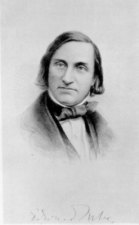
PROFESSOR EDWARD FORBES
 DWARD
FORBES, BORN AT DOUGLAS ON THE 12TH OF FEBRUARY, 1815, WAS
THE SECOND AND ELDEST SURVIVING SON OF Edward Forbes, of Oakhill
and Cronkbane, near Douglas, and Jane, eldest daughter and heiress of
William Teare, of Corvalla and Ballabeg,Ballaugh. His
great-grandfather, David, one of the Forbes's of Watertown, was born
in 1707, and, being implicated in the Jacobite troubles of 1745,
settled in the Isle of Mann for a time; his grandfather, Edward,
acquired the property of Oakhill; and his father, also Edward, was a
banker in Douglas. His mother belonged to an old Manx family, who had
held the same estates in Ballaugh for several centuries. She was an
amiable and pious, as well as an intellectual woman. One of her chief
pleasures was in cultivating flowers and rare plants, so that it is
possible that her son may have imbibed his early fondness for botany
from the great interest he saw her take in such things. Till his
twelfth year Edward Forbes was delicate and so was not sent to
school. He lived, accordingly, in a small circle of relatives and
friends, who greatly loved and admired him, and who left him, almost
uncontrolled, to occupy himself intellectually as he pleased, At a
very early age he was looked upon by his family as a child of no
ordinary mind. Before he was ten years old he had become a confirmed
naturalist. A small wing had been added to the house as a museum for
him, which he stored with minerals, fossils, shells, dried sea-weeds,
flowers,butterflies, &c., all duly classified. He had already
begun his geological studies and exhibited a great taste for drawing.
His school course at the Athole House Academy, in Douglas, was thus
described by his old master, Garvin:-" Edward Forbes was, I think,
under my care for about four and a half years, during which time he
read the usual short course in classics, science., &c., but was
not what would be called a good scholar. That this was not for want
of abilities, I need not tell you, but because his time and attention
were devoted to other pursuits. His pencil was seldom or never out of
his hand ; his latin, as other exercises, were curiosities there
never was a vacant space left on his paper, every corner filled up
with a drawing of some creature or other . . . . . His conduct as a
school boy was excellent. I have no recollection of having ever had
to punish him for misconduct of any kind." He was a great favourite
with his school-fellows, though he did not share in any of their
games. One of them wrote of him as follows:-" Edward was always a
remarkably quiet, studious boy. Such a thing as a fight never entered
his head, and he was never known to have quarrelled with any other
boys. His temper was always extremely gentle and sweet; and, at the
same time, he was so looked up to by the rest of the boys that he was
always made umpire in their disputes. . . . All felt that he was
different from themselves, but no one exactly knew how. We all felt
his superiority, but no on us thought of being jealous, he was so
unlike the rest of us".
DWARD
FORBES, BORN AT DOUGLAS ON THE 12TH OF FEBRUARY, 1815, WAS
THE SECOND AND ELDEST SURVIVING SON OF Edward Forbes, of Oakhill
and Cronkbane, near Douglas, and Jane, eldest daughter and heiress of
William Teare, of Corvalla and Ballabeg,Ballaugh. His
great-grandfather, David, one of the Forbes's of Watertown, was born
in 1707, and, being implicated in the Jacobite troubles of 1745,
settled in the Isle of Mann for a time; his grandfather, Edward,
acquired the property of Oakhill; and his father, also Edward, was a
banker in Douglas. His mother belonged to an old Manx family, who had
held the same estates in Ballaugh for several centuries. She was an
amiable and pious, as well as an intellectual woman. One of her chief
pleasures was in cultivating flowers and rare plants, so that it is
possible that her son may have imbibed his early fondness for botany
from the great interest he saw her take in such things. Till his
twelfth year Edward Forbes was delicate and so was not sent to
school. He lived, accordingly, in a small circle of relatives and
friends, who greatly loved and admired him, and who left him, almost
uncontrolled, to occupy himself intellectually as he pleased, At a
very early age he was looked upon by his family as a child of no
ordinary mind. Before he was ten years old he had become a confirmed
naturalist. A small wing had been added to the house as a museum for
him, which he stored with minerals, fossils, shells, dried sea-weeds,
flowers,butterflies, &c., all duly classified. He had already
begun his geological studies and exhibited a great taste for drawing.
His school course at the Athole House Academy, in Douglas, was thus
described by his old master, Garvin:-" Edward Forbes was, I think,
under my care for about four and a half years, during which time he
read the usual short course in classics, science., &c., but was
not what would be called a good scholar. That this was not for want
of abilities, I need not tell you, but because his time and attention
were devoted to other pursuits. His pencil was seldom or never out of
his hand ; his latin, as other exercises, were curiosities there
never was a vacant space left on his paper, every corner filled up
with a drawing of some creature or other . . . . . His conduct as a
school boy was excellent. I have no recollection of having ever had
to punish him for misconduct of any kind." He was a great favourite
with his school-fellows, though he did not share in any of their
games. One of them wrote of him as follows:-" Edward was always a
remarkably quiet, studious boy. Such a thing as a fight never entered
his head, and he was never known to have quarrelled with any other
boys. His temper was always extremely gentle and sweet; and, at the
same time, he was so looked up to by the rest of the boys that he was
always made umpire in their disputes. . . . All felt that he was
different from themselves, but no one exactly knew how. We all felt
his superiority, but no on us thought of being jealous, he was so
unlike the rest of us".
 All
his spare time was spent in natural history pursuits which, except by
his mother', seem to have been generally regarded with good natured
tolerance not unmixed with contempt. As an instance of this it is
said that his old grandmother, Teare, remarked of him:-" Ta mee
credjal naugh vod slane Ellan Vannin sauall yn guilley shoh veih
cheet dy ve ommidan," (" I believe the whole Isle of Mann cannot save
this boy from being a fool.") When he was sixteen his parents
considered that his calling in life should be decided upon * They
entertained exaggerated ideas of his skill as an artist, and could
much better appreciate his drawings than his geological or botanical
speculations. He therefore, hoping for sufficient leisure to follow
science and literature also, consented to make art his profession. He
was placed under the tuition of Sass, a well-known London artist,
who, however, held out so little encouragement to him to make
painting his profession, that he soon abandoned all thought of
formally prosecuting it. By his father's request he went to Edinburgh
in October 1831 to study medicine there, that he might have a
profession to fall back upon in case of necessity. Though ostensibly
engaged in studying medicine he practically devoted his whole time
and energies to his favourite subjects. He cultivated his taste for
natural history under the able teaching of such men as Professors
Jameson and Graham. In his vacations he went on botanizing and
dredging excursions, and he made himself well acquainted with the
fauna of the Irish sea on the shores of his native Isle. In 1833 at
the age of eighteen, in company with a fellow student: he made an
excursion to Norway, where he spent some weeks exploring the wild and
romantic districts of the country, adding to his geological and
botanical observations. Already, at this time, Edward Forbes began to
direct his attention to botanical geography, the forerunner of those
deep and philosophical views respecting the geographical distribution
of the flora and fauna of the world, which he subsequently developed,
and which constitute one of the most interesting and leading features
of all his writings. The summer of 1834 appears to have been mainly
spent in dredging the Irish sea, and continuing the exploration of
the botany, zoology, and geology of the Isle of Mann. During the same
period of 1835 Forbes made a tour through France, Switzerland, and
Germany, and gained thereby more natural history information, and
achieved more original results than any of his previous excursions
had yielded. The spring of 1836 saw Forbes finally renounce medicine,
and devote himself formally to the study of nature. During the summer
he visited the Hebrides and Skye, attended the meeting of the British
Association at Bristol, and finally went to the Isle of Mann. About
the close of November he set out for Paris, with the view of spending
the winter there among the classes and collections of the Sorbonne
and of the jardin des Plantes. In the spring he went to Algiers where
he investigated the land and fresh-water Mollusca. An account of this
expedition was published in the "Annals of Natural History" for May
1839 With the same view of prosecuting his researches in natural
history, he visited Styria and Carniola in 1838, his remarks on which
were published in the "Proceedings of the Botanical Society." On his
return, he read a paper before the British Association at Newcastle,
entitled "On the Distribution of Terrestrial Pulmonifera in Europe."*
In the following spring, 1839, he read a paper before the Wernerian
Society on the Manx Starfishes. In the summer of this year he
delivered at Edinburgh, whilst still a student, a course of
scientific lectures on zoology, as well as one of a more popular
bearings of zoology nature in which he pointed out the be on geology,
thus indicating the commencement of those views which, by their
subsequent development and their growing importance in his hands,
have exercised such a beneficial and practical influence on the study
of geology. The summer of 1840, was spent in dredging in Ireland and
the Isle of Mann and in working at his "History of British
Star-fishes and other Echinodermes," a delightful volume, charmingly
illustrated by his own pencil, which was published in 1841. The time
was now fast approaching when Edward Forbes was to find a wider
sphere for the exercise of his brilliant genius. In February, 1841,
he obtained the appointment of Naturalist to H.M.S. surveying ship
Beacon, Captain Graves, then employed in completing the survey
of the coast of Asia Minor and the adjacent islands: an
appointment more suited to his tastes and to his talents could
not have been devised. He had here full play for the prosecution of
his favourite pursuits of botany, zoology, and geology.
Already well acquainted with the flora and fauna of the European
Continent and their geographical distribution, he had now an
opportunity of tracing their future extension to the East, and of
examining the first appearance of that Oriental facies which
they put on in the Eastern portions of the Mediterranean. Nor was
Edward Forbes the man to neglect such an opportunity. During this and
the following year he pursued his botanical and zoological researches
with unwearied energy. It was during his various excursions in the
Beacon and her boats that he followed out those researches
with the dredge, amongst the Islands of the Aegean Sea and on the
adjacent coast of Asia Minor, which alone would have immortalized his
name. At the same time he neglected no occasion of studying the
geology and botany of the regions in which he visited, but the dredge
and its results will ever remain the chief glory of this expedition.
The results of these researches were made known to the public in the
"Report on the Mollusca and Radiata of the Aegean Sea and on their
Distribution, considered as bearing on Geology," made to the British
Association at their meeting at Cork in 1843. The calculations were
based on more than one hundred fully-recorded dredging operations in
various depths from 1 to 130 fathoms, and In many localities from the
shores of the Morea to those of Asia Minor. And with that modesty
which ever characterized Edward Forbes in all his works, he adds that
the merit of the results is mainly due to Captain Graves. The most
important fact which has resulted from this valuable report
respecting the development and distribution of animal and vegetable
life in the depths of the sea is that of the almost uniform
occurrence of particular species in particular zones of depth. During
his stay in the Mediterranean he made several excursions into Lycla,
where he and his companions explored and determined the sites of
twenty ancient cities hitherto unknown to geographers, and the names
of fifteen were identified by inscriptions found among the ruins. His
life was at one time in danger from the malignant malaria of the
country, when there can be little doubt were sown the seeds of that
disease which eventually put an end to his life so prematurely. He,
however, gradually recovered, and was at the point of proceeding to
Egypt and the Red Sea on a dredging expedition in the autumn of 1842,
when he heard that he had been elected to fill the chair of Botany in
King's College, London. At the end of the year he was also appointed
Assistant- Secretary of the Geological Society of London, the duties
of which important office he performed to the satisfaction of all
concerned. Early in 1843 he joined the Linnaean Society. In February
he delivered an able lecture before the Royal Institution on "The
light thrown on Geology by submarine researches," one of the results
of which was that he was offered the Fullerian Professorship of
natural history. He was, however, obliged to decline it, not having
time to fulfil its duties. On the first of May he began his botanical
lectures at King's College. At the end of 1844, on the establishment
of the Museum of Practical Geology in connection with the Ordnance
Geological Survey, Professor Forbes was appointed paleontologist to
that institution, and, consequently, resigned his post at the
Geological Society. When the museum was removed to Jermyn Street he
became its Professor of Natural History. Here then his talents had
full space for their development, and Edward Forbes was not slow in
bringing to bear on his numerous avocations the knowledge he had so
industriously collected. Combining as he did a lively and vivid
imagination with a mature and well-disciplined judgment he was
enabled to employ with effect that power of generalization and
abstraction which he so eminently possessed. His enlightened and
comprehensive views on the numerous branches of natural history which
he cultivated, and which were founded mainly on his own experience,
caused him from henceforth to be looked up to as one of the first of
British naturalists, and the works which he now published bear ample
testimony to his well-founded reputation. Nor was it in England alone
that his merits were recognized. In France, in Germany, in Italy,
wherever men of science were to be found, the name of Edward Forbes
was equally acknowledged as deserving a place in the first rank of
scientific merit.
All
his spare time was spent in natural history pursuits which, except by
his mother', seem to have been generally regarded with good natured
tolerance not unmixed with contempt. As an instance of this it is
said that his old grandmother, Teare, remarked of him:-" Ta mee
credjal naugh vod slane Ellan Vannin sauall yn guilley shoh veih
cheet dy ve ommidan," (" I believe the whole Isle of Mann cannot save
this boy from being a fool.") When he was sixteen his parents
considered that his calling in life should be decided upon * They
entertained exaggerated ideas of his skill as an artist, and could
much better appreciate his drawings than his geological or botanical
speculations. He therefore, hoping for sufficient leisure to follow
science and literature also, consented to make art his profession. He
was placed under the tuition of Sass, a well-known London artist,
who, however, held out so little encouragement to him to make
painting his profession, that he soon abandoned all thought of
formally prosecuting it. By his father's request he went to Edinburgh
in October 1831 to study medicine there, that he might have a
profession to fall back upon in case of necessity. Though ostensibly
engaged in studying medicine he practically devoted his whole time
and energies to his favourite subjects. He cultivated his taste for
natural history under the able teaching of such men as Professors
Jameson and Graham. In his vacations he went on botanizing and
dredging excursions, and he made himself well acquainted with the
fauna of the Irish sea on the shores of his native Isle. In 1833 at
the age of eighteen, in company with a fellow student: he made an
excursion to Norway, where he spent some weeks exploring the wild and
romantic districts of the country, adding to his geological and
botanical observations. Already, at this time, Edward Forbes began to
direct his attention to botanical geography, the forerunner of those
deep and philosophical views respecting the geographical distribution
of the flora and fauna of the world, which he subsequently developed,
and which constitute one of the most interesting and leading features
of all his writings. The summer of 1834 appears to have been mainly
spent in dredging the Irish sea, and continuing the exploration of
the botany, zoology, and geology of the Isle of Mann. During the same
period of 1835 Forbes made a tour through France, Switzerland, and
Germany, and gained thereby more natural history information, and
achieved more original results than any of his previous excursions
had yielded. The spring of 1836 saw Forbes finally renounce medicine,
and devote himself formally to the study of nature. During the summer
he visited the Hebrides and Skye, attended the meeting of the British
Association at Bristol, and finally went to the Isle of Mann. About
the close of November he set out for Paris, with the view of spending
the winter there among the classes and collections of the Sorbonne
and of the jardin des Plantes. In the spring he went to Algiers where
he investigated the land and fresh-water Mollusca. An account of this
expedition was published in the "Annals of Natural History" for May
1839 With the same view of prosecuting his researches in natural
history, he visited Styria and Carniola in 1838, his remarks on which
were published in the "Proceedings of the Botanical Society." On his
return, he read a paper before the British Association at Newcastle,
entitled "On the Distribution of Terrestrial Pulmonifera in Europe."*
In the following spring, 1839, he read a paper before the Wernerian
Society on the Manx Starfishes. In the summer of this year he
delivered at Edinburgh, whilst still a student, a course of
scientific lectures on zoology, as well as one of a more popular
bearings of zoology nature in which he pointed out the be on geology,
thus indicating the commencement of those views which, by their
subsequent development and their growing importance in his hands,
have exercised such a beneficial and practical influence on the study
of geology. The summer of 1840, was spent in dredging in Ireland and
the Isle of Mann and in working at his "History of British
Star-fishes and other Echinodermes," a delightful volume, charmingly
illustrated by his own pencil, which was published in 1841. The time
was now fast approaching when Edward Forbes was to find a wider
sphere for the exercise of his brilliant genius. In February, 1841,
he obtained the appointment of Naturalist to H.M.S. surveying ship
Beacon, Captain Graves, then employed in completing the survey
of the coast of Asia Minor and the adjacent islands: an
appointment more suited to his tastes and to his talents could
not have been devised. He had here full play for the prosecution of
his favourite pursuits of botany, zoology, and geology.
Already well acquainted with the flora and fauna of the European
Continent and their geographical distribution, he had now an
opportunity of tracing their future extension to the East, and of
examining the first appearance of that Oriental facies which
they put on in the Eastern portions of the Mediterranean. Nor was
Edward Forbes the man to neglect such an opportunity. During this and
the following year he pursued his botanical and zoological researches
with unwearied energy. It was during his various excursions in the
Beacon and her boats that he followed out those researches
with the dredge, amongst the Islands of the Aegean Sea and on the
adjacent coast of Asia Minor, which alone would have immortalized his
name. At the same time he neglected no occasion of studying the
geology and botany of the regions in which he visited, but the dredge
and its results will ever remain the chief glory of this expedition.
The results of these researches were made known to the public in the
"Report on the Mollusca and Radiata of the Aegean Sea and on their
Distribution, considered as bearing on Geology," made to the British
Association at their meeting at Cork in 1843. The calculations were
based on more than one hundred fully-recorded dredging operations in
various depths from 1 to 130 fathoms, and In many localities from the
shores of the Morea to those of Asia Minor. And with that modesty
which ever characterized Edward Forbes in all his works, he adds that
the merit of the results is mainly due to Captain Graves. The most
important fact which has resulted from this valuable report
respecting the development and distribution of animal and vegetable
life in the depths of the sea is that of the almost uniform
occurrence of particular species in particular zones of depth. During
his stay in the Mediterranean he made several excursions into Lycla,
where he and his companions explored and determined the sites of
twenty ancient cities hitherto unknown to geographers, and the names
of fifteen were identified by inscriptions found among the ruins. His
life was at one time in danger from the malignant malaria of the
country, when there can be little doubt were sown the seeds of that
disease which eventually put an end to his life so prematurely. He,
however, gradually recovered, and was at the point of proceeding to
Egypt and the Red Sea on a dredging expedition in the autumn of 1842,
when he heard that he had been elected to fill the chair of Botany in
King's College, London. At the end of the year he was also appointed
Assistant- Secretary of the Geological Society of London, the duties
of which important office he performed to the satisfaction of all
concerned. Early in 1843 he joined the Linnaean Society. In February
he delivered an able lecture before the Royal Institution on "The
light thrown on Geology by submarine researches," one of the results
of which was that he was offered the Fullerian Professorship of
natural history. He was, however, obliged to decline it, not having
time to fulfil its duties. On the first of May he began his botanical
lectures at King's College. At the end of 1844, on the establishment
of the Museum of Practical Geology in connection with the Ordnance
Geological Survey, Professor Forbes was appointed paleontologist to
that institution, and, consequently, resigned his post at the
Geological Society. When the museum was removed to Jermyn Street he
became its Professor of Natural History. Here then his talents had
full space for their development, and Edward Forbes was not slow in
bringing to bear on his numerous avocations the knowledge he had so
industriously collected. Combining as he did a lively and vivid
imagination with a mature and well-disciplined judgment he was
enabled to employ with effect that power of generalization and
abstraction which he so eminently possessed. His enlightened and
comprehensive views on the numerous branches of natural history which
he cultivated, and which were founded mainly on his own experience,
caused him from henceforth to be looked up to as one of the first of
British naturalists, and the works which he now published bear ample
testimony to his well-founded reputation. Nor was it in England alone
that his merits were recognized. In France, in Germany, in Italy,
wherever men of science were to be found, the name of Edward Forbes
was equally acknowledged as deserving a place in the first rank of
scientific merit.
[TO
BE CONTINUED.]
The memoire of Edward Forbes by George Wilson, M.D., F.R.S.E., and
Archibald Geikie, F.R.S.E., F.G.S., has been largely made use of in
the compilation of this article.
*In this year his 'Malacologia Monensis, a
Catalogue of the Manx Mollusca,