[From ManxNoteBook vol i,1885]
 HE
occurrence of a Fylfot of remarkable, if not unique, character, on
one of the fine old sculptured crosses in which the Isle of Mann is
so peculiarly rich, affords opportunity which I gladly seize, of
giving in the first number of a journal devoted to the consideration
of Manx Antiquities, a few words upon that figure and on its meaning
and symbolism. The stone to which I allude is at Onchan, and is, so
far as I am at present aware, the only instance of the occurrence of
a Fylfot on any of the ancient sculptured stones on the Island. On
some others, as I may possibly take occasion to point out, the
ornamentation partakes of the Fylfot form and feeling, but no other
distlnct and clear example I believe occurs.
HE
occurrence of a Fylfot of remarkable, if not unique, character, on
one of the fine old sculptured crosses in which the Isle of Mann is
so peculiarly rich, affords opportunity which I gladly seize, of
giving in the first number of a journal devoted to the consideration
of Manx Antiquities, a few words upon that figure and on its meaning
and symbolism. The stone to which I allude is at Onchan, and is, so
far as I am at present aware, the only instance of the occurrence of
a Fylfot on any of the ancient sculptured stones on the Island. On
some others, as I may possibly take occasion to point out, the
ornamentation partakes of the Fylfot form and feeling, but no other
distlnct and clear example I believe occurs.
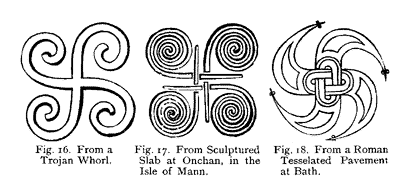
The slab, of which an engraving appears on Plate VI of "The Runic and other Monumental Remains of the Isle of Mann," by my friend the late Rev. J. G. Cumming, bears, in relief, a cross, with surrounding circle and shaft, whose entire surfaces are covered with an elaborate guilloche pattern, the intricate interlacing of which is well defined. This shafted cross occupies about two-thirds of the length of the slab, and is surrounded by an outline terminating in a scroll on each side at the foot. On either side the shaft is a grotesque animal, and at the foot a line of scroll -ornament, from which rises, on each side, a simple band terminating in scrolls behind and above their heads. On the lower part of the slab below the scroll-ornament base of the cross, and entirely clear and distinct from it, and independent of all other ornament or device is the Fylfot to which I am about to dlrect attention ; it is placed somewhat diagonally upon the plain portion of the slab, and measures about a foot from limb to limb. This Fylfot which, as I have said, is remarkable if not unique in its development, I have had engraved on Fig. 17. It is, as will be then seen, formed of four crozier-like limbs whose shafts intersed each other in the centre; the scrolls being three-fold.
The "Fylfot," "Fytfot," "Gammadion," or "Thorr's Hammer," as it is
variously called-"the dissembled cross under the discipline of the
secret "-is one of the most curious and ancient forms of cross, and
its mysticism and symbolism are very marked. By some writers it is
said to be formed of four gammas conjoined in the centre "which, as
numerals, expressed the Holy Trinity, and, by its rectangular form,
symbolized the chief cornerstone of the church "; by others, to be
formed of the two words su and asti, meaning "it is
well," or "so be it," and implying complete resignation. From this
the Swastikas, the opponents of the Brahmins, received their name ;
"their monogrammatic emblem, or symbol, being the mystic cross
 formed by the combination of two syllables su x ti
=suti, or swasti." With all this, however, I have nothing to do on
the present occasion. Heraldically, the Fylfot may be described as a
cross cramponn6e, or rebated. In its proper proportion, as I have on
other occasions shewn, it is a square area divided into twenty-five
square parts (i. e., five each way) thus (Fig. i) of which seventeen
form the figure.
formed by the combination of two syllables su x ti
=suti, or swasti." With all this, however, I have nothing to do on
the present occasion. Heraldically, the Fylfot may be described as a
cross cramponn6e, or rebated. In its proper proportion, as I have on
other occasions shewn, it is a square area divided into twenty-five
square parts (i. e., five each way) thus (Fig. i) of which seventeen
form the figure.
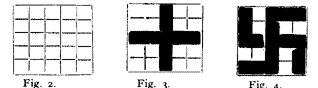
It is, therefore, simply a plain Greek cross, or cross of St. George, composed of nine of these squares (as in Fig. 2) with the terminations of the limbs rebated and continued to the outer edges of the general square, as shewn on Fig. 3. Or, in other words, it is a plain cross of five squares within a border of similar squares from which the fourth (or second) on each side has been omitted. In this, its simple, form it occurs, as I shall presently show, from the very earliest times from which art-relics have come down to us and among nations and peoples far removed from each other in their geographical distribution, in sentiments, and in religion.
In northern mythology the Fylfot is known as the Hammer of Thorr, the Scandinavian
God, or Thunderer, and is called "Thorr's Hammer " or the "Thunderbolt." The
same is said of the Tau which, though somewhat hammer-shaped according to our
form of hammer, bears no possible resemblance to the ancient emblem of the thunderbolt.
The Scandinavian god Thorr, whose day Thorrsday or Thursday stands between
those of his father (Wodin or Odin, Wodensday, Wednesday,)
and mother (Fria or Friga, Friasday, Friday) was "the bravest of
the sons of Odin" and "believed to bee of the moste marvellous power and might
; yea, and that there were no people throughout the whole world that were not
subjected unto him, and did not owe him divine honour and service; that there
was no puissance comparable unto his. His dominion of all others most farthest
extending itself, both in heaven and earth. That in the air he governed the
winds and the cloudes ; and being displeased, did cause lightning, thunder,
and tempest, with excessive raine, halle, and all ille weather. But, being well
pleased by the adoration, sacrifice, and service of his suppliants he then bestowed
upon them most faire and seasonable weather ; and caused corne abundantly to
growe ; as all sorts of fruites, &c. ; and kept away the plague and all
other evill and infectious diseases." The emblem of this god, Thorr or the Thunderer,
was, as I have said, a thunderbolt or hammer of gold, which hammer was frequently
represented as a Fylfot. His hammer, it is said, had the peculiar property that
whenever thrown it never failed to strike the object at which it was aimed and
always returned or flew back to his hand.* This property will be recognised
as similar to that of the boomerang; and here, surely, as I have already on
another occasion advanced, we have a curious and interesting insight into the
origin of the form of the emblem itself. As I have just said, the fylfot is
described by some writers as being formed of four gammas conjoined in the centre.
The formef the boomerang, something like a letter V,
with a rounded, instead of pointed, bottom, bears a marked resemblance to the
ancient gamma, and it is a missile instrument, which on being skilfully thrown,
slowly ascends into the air, whirling round and round till it reaches a considerable
height and then returns, until it finally sweeps over the head of the thrower
and strikes the ground or other object behind him. When this power, and the
form of the boomerang, are remembered in connection with the traditional returning
power of the hammer, the Fylfot may surely be not inappropriately described
as a figure composed of four boomerangs conjoined in the centre  and thus emblematise the "Thunderer's" power. This form of Fylfot is not at
all uncommon on early examples from Troy and other places and countries. It
is indeed simply the ordinary Fylfot with the angles rounded
and thus emblematise the "Thunderer's" power. This form of Fylfot is not at
all uncommon on early examples from Troy and other places and countries. It
is indeed simply the ordinary Fylfot with the angles rounded  almost as though formed of two S's crosswise.
 The
Fylfot is found on early Scandinavian, Danish, Indian, and Gaulish
coins, as well as those of Syracuse, Corinth, and Chalcedon. It is
also occasionally found on Anglo-Saxon coins; on one of these, of the
sixth or seventh century, the rebate of each of the limbs does not
start from quite the top, and is pointed. Some of the ancient Danish
coins on which the emblem appears, bear also the name of Thorr in
runes.
The
Fylfot is found on early Scandinavian, Danish, Indian, and Gaulish
coins, as well as those of Syracuse, Corinth, and Chalcedon. It is
also occasionally found on Anglo-Saxon coins; on one of these, of the
sixth or seventh century, the rebate of each of the limbs does not
start from quite the top, and is pointed. Some of the ancient Danish
coins on which the emblem appears, bear also the name of Thorr in
runes.
One of the most remarkable assemblages of objects of high antiquity upon which
the Fylfot appears is that of the terra-cotta whorls, pottery, and the like,
brought to light by Dr. Schliemann, and figured in his work upon Troy and
its Remains. With regard to these the doctor remarks that he had frequently
found both the  and
and  the on remains
during the course of excavations without at first being able to understand their
meaning. After researches in different works, however, he came to the conclusion
,that both the
and the which
he found in Emile Burnouf's Sanscit Lexicon under the name of Suastika, and
as to the meaning of .... or, as the sign of good-wishes, were already regarded,
thousands of years before Christ, as religious symbols of the very greatest
importance among the early, progenitors of the Aryan races in Bactrl'a, and
in the villages of the Oxiis, at a time when the Germans, Indians, Pelasgians,
Celts, Persians, Sclavonians, and Iraiilans, still formed one nation and spoke
one langitage ; " and he proceeds to cite a vast number of instances in which
he, in the course of his investigations, has found it occurring. Without, however,
following him, or Emile Biirnotif, or Max Muller, or other works, to which those
who wish to pursue the subject further may be glad to refer, but from which
space would not allow me to quote, I will proceed to give a few examples that
will be useful for reference and comparison.
the on remains
during the course of excavations without at first being able to understand their
meaning. After researches in different works, however, he came to the conclusion
,that both the
and the which
he found in Emile Burnouf's Sanscit Lexicon under the name of Suastika, and
as to the meaning of .... or, as the sign of good-wishes, were already regarded,
thousands of years before Christ, as religious symbols of the very greatest
importance among the early, progenitors of the Aryan races in Bactrl'a, and
in the villages of the Oxiis, at a time when the Germans, Indians, Pelasgians,
Celts, Persians, Sclavonians, and Iraiilans, still formed one nation and spoke
one langitage ; " and he proceeds to cite a vast number of instances in which
he, in the course of his investigations, has found it occurring. Without, however,
following him, or Emile Biirnotif, or Max Muller, or other works, to which those
who wish to pursue the subject further may be glad to refer, but from which
space would not allow me to quote, I will proceed to give a few examples that
will be useful for reference and comparison.
I have already given example of the ordinary form and correct proportion of the Fylfot on Fig. 4, and now give an actual example on Fig. 12, following
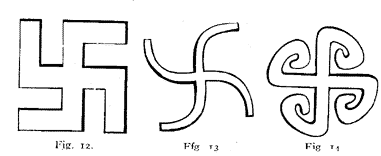
it up with others, to show its gradual development into the ornate form in which it. appears at Onchan and other places. Fig. 13 ' is from one of the Trojan whorls, and from other sources, and Fig. 14, from a curious sculptured stone, part of the shaft of a cross, at Dearham, in Ctimberland. On this piece of sculpture the Fylfot, which is twice repeated, occurs in the lower part of the shaft, surrounded by rude spiral and other ornaments.
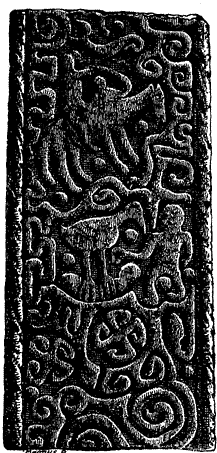 Above
them is a human figure holding out its hand in front of an enormous bird, which
is resting upon, possibly, a prostrate child. Above this again, surrounded with
scroll work, is a mounted horseman. This piece of ancient sculpture, which was
only lately discovered, was communicated to the Cumberland and Westmorland Society
and to The Reliquary, by the Vicar of Dearham, the Rev. W. S. Calverley,
ranks among the more curious examples of the fylfot. That side of the shaft
upon which it occurs is here engraved. A further development of the same form
is Fig. 16, from a Trojan whorl; and the next, more elaborated still, is the
remarkable cursive example on the sculptured slab, at Onchan, in the lsleof
Mann. An other curious development is the next, which I here copy from a Roman
tesselated pavement at Bath.
Above
them is a human figure holding out its hand in front of an enormous bird, which
is resting upon, possibly, a prostrate child. Above this again, surrounded with
scroll work, is a mounted horseman. This piece of ancient sculpture, which was
only lately discovered, was communicated to the Cumberland and Westmorland Society
and to The Reliquary, by the Vicar of Dearham, the Rev. W. S. Calverley,
ranks among the more curious examples of the fylfot. That side of the shaft
upon which it occurs is here engraved. A further development of the same form
is Fig. 16, from a Trojan whorl; and the next, more elaborated still, is the
remarkable cursive example on the sculptured slab, at Onchan, in the lsleof
Mann. An other curious development is the next, which I here copy from a Roman
tesselated pavement at Bath.
Fig. 15, Shaft of Cross, at Dearham.
Among other remarkable instances of the occurrence of the Fylfot, to which it will be well to direct attention, is the singular piece of scultpture the foot-prints of Buddha, as carved on the Amraverti Tope, near the River Kistna.
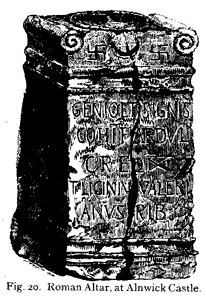
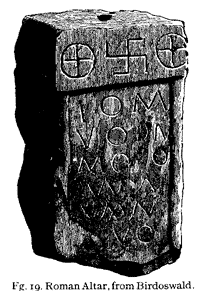 The
sculpture represents the carved impress of the feet of Buddha within
a border of foliage and animals. On each of the ten toes is carved a
Fylfot, and the same emblem appears also, with others, twice upon
each heel and once upon the cushion, or ball, of each foot. It is
occasionally met with on Roman Altars in our own country; good
examples being those from Brememium and Birdoswald on the Roman Wall,
and another preserved in Alnwick Castle. The thunderbolt also occurs
on some altars along with, or witlioiit, the wheel of Nemesis, and
more especialy and markedly, on one from the Risingham Station where
it partakes, closely of the Fylfot form.
The
sculpture represents the carved impress of the feet of Buddha within
a border of foliage and animals. On each of the ten toes is carved a
Fylfot, and the same emblem appears also, with others, twice upon
each heel and once upon the cushion, or ball, of each foot. It is
occasionally met with on Roman Altars in our own country; good
examples being those from Brememium and Birdoswald on the Roman Wall,
and another preserved in Alnwick Castle. The thunderbolt also occurs
on some altars along with, or witlioiit, the wheel of Nemesis, and
more especialy and markedly, on one from the Risingham Station where
it partakes, closely of the Fylfot form.
 Those
of my readers who are fortunate enough to possess Dr. Bruce's
LapidariiumSeptentrionale will find these examples engraved;.
and they will also be found in Vol. XXII of The Reliquary.
Those
of my readers who are fortunate enough to possess Dr. Bruce's
LapidariiumSeptentrionale will find these examples engraved;.
and they will also be found in Vol. XXII of The Reliquary.
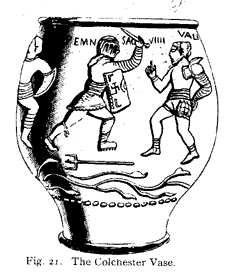 It
is curious also to note, in connectlon with these Roman examples, that the Fylfot
occurs (besides on other Roman, - Etruscan, Chinese, and other pottery) on the
famous Colchester vase, of which I append an engraving (Fig. 21) and that it
is also met with on the paintings which occur in the Catacombs of Rome * The
Colchester vase, so called because it was found in the Roman Cemetery, which
formed the site of West Lodge, near that city, where it had been used as a sepulchral
urn, bears as one of the three groups with which it is decorated, a representation
of a combat between twogladiators-a Secutor and a Retiarius. The
former, wearing a close helmet and armed with sword and shield, is advancing
upon his conquered adversary prepared to strike the fatal blow, while the latter,
who has been vanquished, has dropped his trident and is elevating his right
hand to implore mercy from the spectators. It is on the shield of the Secutor
that the Fylfot occurs and is probably there placed as an emblem of asserted
power and victory.
It
is curious also to note, in connectlon with these Roman examples, that the Fylfot
occurs (besides on other Roman, - Etruscan, Chinese, and other pottery) on the
famous Colchester vase, of which I append an engraving (Fig. 21) and that it
is also met with on the paintings which occur in the Catacombs of Rome * The
Colchester vase, so called because it was found in the Roman Cemetery, which
formed the site of West Lodge, near that city, where it had been used as a sepulchral
urn, bears as one of the three groups with which it is decorated, a representation
of a combat between twogladiators-a Secutor and a Retiarius. The
former, wearing a close helmet and armed with sword and shield, is advancing
upon his conquered adversary prepared to strike the fatal blow, while the latter,
who has been vanquished, has dropped his trident and is elevating his right
hand to implore mercy from the spectators. It is on the shield of the Secutor
that the Fylfot occurs and is probably there placed as an emblem of asserted
power and victory.
 Over
the head of the Secutor are the letters MEMN - N SAC - VI III, which
(taking it for granted that the A in SAC should be E) has been read
as Memnivs [or Memmon] numeri secutorum
victor ter, or, Memnius [or Memnon] of the number [or
band] of secutors, conqueror thrice" ; over that of the
Retiariiis, VALENTINV LEGIONIS XXX, meaning, clearly, "Valentinus of
the thirtieth legion," who was, doubtless, the vanquished one whose
figure appears. On another vase, which I give as a companion to this
(Fig. 22), a nude figure is represented holding the thunderbolt.
Over
the head of the Secutor are the letters MEMN - N SAC - VI III, which
(taking it for granted that the A in SAC should be E) has been read
as Memnivs [or Memmon] numeri secutorum
victor ter, or, Memnius [or Memnon] of the number [or
band] of secutors, conqueror thrice" ; over that of the
Retiariiis, VALENTINV LEGIONIS XXX, meaning, clearly, "Valentinus of
the thirtieth legion," who was, doubtless, the vanquished one whose
figure appears. On another vase, which I give as a companion to this
(Fig. 22), a nude figure is represented holding the thunderbolt.
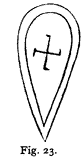
From the time of the Romans, or, earlier still, from that of the
Norsemen, the Fylfot has, in one way or otliei-, been used down to
the present day in our own country. Besides the earlier examples to
which I have referred, and many others that could be cited, it is,
later on, found on a shield on the Bayeux tapestry (Fig. 23), and,
later still, is not unfrequently met with on monumental brasses and
sculptured effigies of ecclesiastics, military, and laymen.
 Thus, on
the examples here engraved (Figs. 24 to 28), it forms, on the brass
of Thomas de Hop (circa 1300) a priest, In Kems'ng Church,
alternately with quatrefoils, a border on the collar of the chasuble;
on that of Richard Hakebourne, in Merton College, on the border of
the collar and sleeves; on the collar of the chasuble of the brass of
Walter Frilend's, at Oakham, Surrey, and John Alderburne at Lewknor
and others ; and on those of Bishop Branscomb, Sir John D'Abernoun,
and manyothers. It may, probably, have been adopted by Christians
through its "consisting of four gammas, which, as numerals, expressed
the Holy Trinity, and, by its rectangular form, symbolized the chief
corner-stone of the church."
Thus, on
the examples here engraved (Figs. 24 to 28), it forms, on the brass
of Thomas de Hop (circa 1300) a priest, In Kems'ng Church,
alternately with quatrefoils, a border on the collar of the chasuble;
on that of Richard Hakebourne, in Merton College, on the border of
the collar and sleeves; on the collar of the chasuble of the brass of
Walter Frilend's, at Oakham, Surrey, and John Alderburne at Lewknor
and others ; and on those of Bishop Branscomb, Sir John D'Abernoun,
and manyothers. It may, probably, have been adopted by Christians
through its "consisting of four gammas, which, as numerals, expressed
the Holy Trinity, and, by its rectangular form, symbolized the chief
corner-stone of the church."
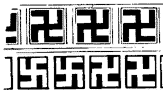
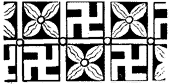
Fig 24 Fig 25

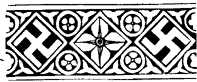
Fig 26 Fig 27 Fig 28
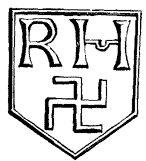
The Fylfot either in its simple form,
or of more or less complicated development or combined with other
Figures, was also a favourite device upon iiledlxval bells, and
enters, not unfrequently, into the marks adopted by their founders,
more especially those of the midland coiintiesof England.
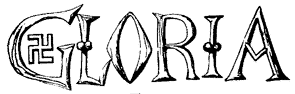
Of these, I give engravings of one or two examples on Figs. 31 to 33. As the ringing of the church bells in times of tempest was superstitiously believed to drive away thunder, probably
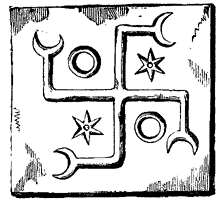
the old Thunderer superstition that had not died out of the popular mind might have had something to do with the putting thereon the sign of Thorr, who was believed to have power over storms and tempests, and of himself throwing the thunderbolts.
 I
have said, perhaps, enough on the subject to show that more than a
passing interest attaches itself to even so apparently trivial a
matter as the occurrence of an out-of-the-way ornament on a slab in a
village church-yard, and, I trust, by so doing I may lead others to
examine more closely the remains of past ages that are spread so
lavishly over the length and breadth of the island, and to note their
peculiarities, trace out their symbolism and hidden meaning, and give
to the world the result of their researches.
I
have said, perhaps, enough on the subject to show that more than a
passing interest attaches itself to even so apparently trivial a
matter as the occurrence of an out-of-the-way ornament on a slab in a
village church-yard, and, I trust, by so doing I may lead others to
examine more closely the remains of past ages that are spread so
lavishly over the length and breadth of the island, and to note their
peculiarities, trace out their symbolism and hidden meaning, and give
to the world the result of their researches.
The Hollies,
Duffield, Derby.
* His weapon being a thunderbolt it was of course but natural that a belief should spring up that it returned to him after striking where aimed, else, how could he again throw it ?
|
|
||
|
|
||
|
Any comments, errors or omissions
gratefully received The
Editor |
||


